Acrylgel, Polygel or Builder Gel with Popits? Find out which product to choose, how to avoid bubbles and overspill, and how to achieve perfect extensions with LuluNails Belgium.
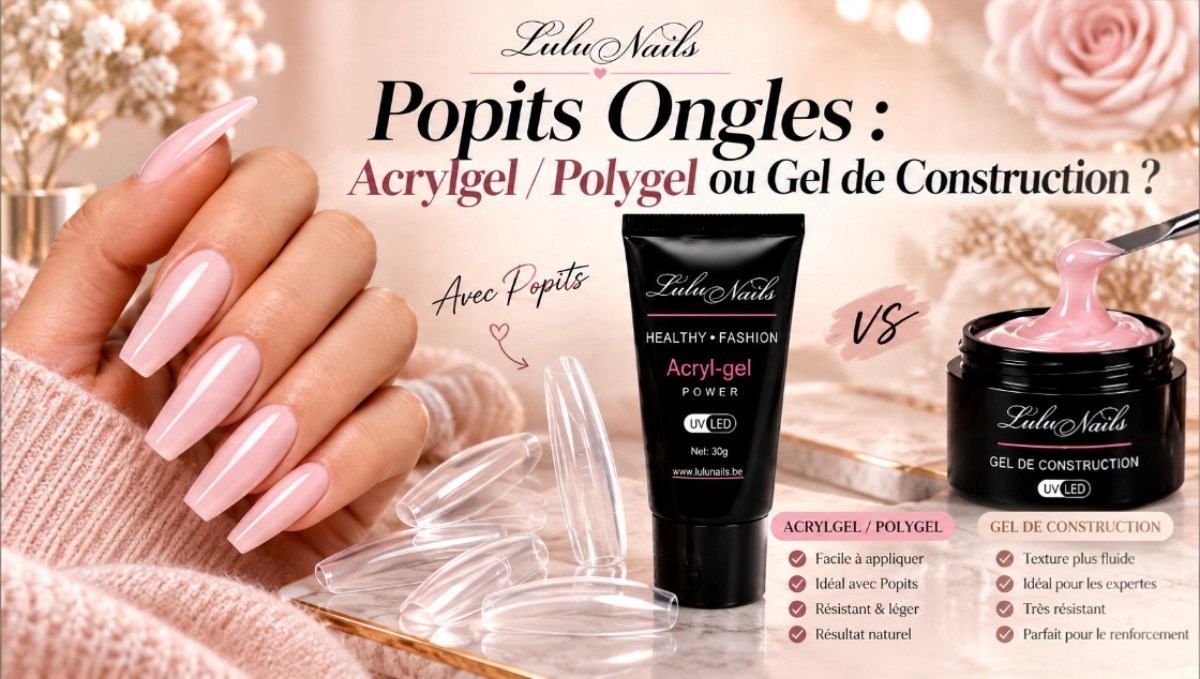
Popits Nails: Acrylgel or Builder Gel? Which Material to Choose for a Perfect Application | LuluNails Belgium
Popits for nails have become a highlypopular technique for quickly creating extensions with a uniform shape.
But one question keeps coming up:
Which material should you use in a Popit?
Acrygel? Polygel? Builder gel? Thick builder gel? Self-levelling gel?
Not all UV/LED materials have the same viscosity, and a texture that’s ideal for a classic wrap isn’t necessarily the easiest to work with in a Popit.
In this comprehensive guide, LuluNails Belgium explains how to choose between acrylgel, polygel and builder gel, how to select the right Popit and what mistakes to avoid to achieve a neat and well-structured
Whatis a Popit for nails?
A Popit is a reusable mould used to create the outer shape of a nail extension directly.
The material is placed inside the Popit, then the mould is positioned on the natural nail.
After curing under a compatible UV/LED lamp, the Popit is removed.
The build then remains on the nail.
This technique can be used to quickly achieve a smooth surface and a predefined shape.
It is particularly used with materialsthat are sufficiently stable, such as Acrylgel/Polygel and certain suitable builder gels.
Why have Popits become so popular?
The technique can be useful for both beginners and professionals becauseit makes it easier to create a uniform shape.
In particular, it can help you work on length and shape more quickly, reduce certain filing steps when applied correctly, and to reproduce a similar shape more easily on several fingers.
However, the Popit does not do everything automatically.
The result still depends on four essential elements:
the choice of Popit the amount of material its positioning the design created.
Acrygel or Polygel: why is it particularly suitable for Popits?
Acrylgel, also known as Polygel, generally has a much more stable texture than a very runny gel.
It is precisely this stability that makes it particularly practical for use in a Popit.
When you place the material in the mould, it generally stays there where you work it until it cures.
This gives you more time to shape the nail before applying the Popit.
The LuluNails Acrylgel/Polygel range is currently designed for nail strengthening and extensions and comes in several colours, including Nude, Milky, White and various shades. LuluNails
The main advantage of Acrylgel with a Popit
It does not self-level quickly like a very runny gel.
This makes it easier to control the product before placing the mould on the nail.
This can be particularly useful when learning the technique.
Can you use builder gel with Popits?
Yes, provided the gel chosen has properties suitable for this technique.
This is where viscosity becomes important.
A very runny Builder Gel may be excellent for a self-levelling base coat but can become more difficult to control in a Popit.
Conversely, a thicker or more stable gel generally allows for greater control.
At LuluNails, the Gel Construction range currently includes various shades in 15 g and 30 g sizes, designed for building, strengthening and extensions. LuluNails
Before using a LuluNails product in a Popit, always check that its properties are suitable for this technique.
Acrygel or Builder Gel for Popits: which one to choose?
Here is the most important difference.
| Criterion | Acrygel / Polygel | Builder Gel |
|---|---|---|
| Texture | Very stable | Varies depending on viscosity |
| Self-levelling | Low | May be significant |
| Working time | Very controllable | Depends on viscosity |
| Risk of running before curing | Low | Greater with fluid gel |
| Popits | Very practical | Yes, if the gel is suitable |
| Long extensions | Very interesting | Depends on the gel’s rigidity |
| Suitable for beginners | Easy to control | More technical if using a fluid gel |
| Shaping before curing | Very easy | Depends on the gel |
| UV/LED lamp | Yes | Yes |
For a beginner
I would generally opt for a stable material such as Acrylgel.
For a fast-working professional
A sufficiently stable builder gel can be extremely effective.
For someone used to self-levelling gels
You must pay particular attention to the quantity and positioning before curing.
Which Popit should you choose?
Choosing the right mould is just as important as choosing the right material.
A Popit must not be too small.
It must cover the width of the natural nail properly without exerting excessive pressure on the sides.
If you have to force it significantly to cover the nail plate, generally choose the next size up and then adjust it ifnecessary.
A Popit that is too narrow can result in a build that is ill-suited to the nail.
A Popit that is too wide may require further adjustments.
The aim is for the mould to match the width and curvature of the nail as naturally as possible.
How much Acrylgel should be placed in a Popit?
There is no single quantity that applies to all nails.
The amount depends, in particular, on the width of the nail plate, the desired length, the shape and the structure.
However, you should avoid two extremes.
Not enough product
The build-up may become too thin, particularly in certain key areas.
Too much material
When positioning the Popit, the product may spill out significantly at the sides and towards the cuticles.
The aim is therefore to distribute the material before applying the Popit, rather than placing a large lump and hoping that the pressure will automatically build up the nail.
How do you spread the Acrylgel in the Popit?
Place the required amount inside the mould, then work it in using a suitable brush.
For Acrygel, a shaping solution compatible with the system used can make modelling easier.
Gradually build up a consistent structure: thinner towards the cuticles, sufficiently structured in the area requiring reinforcement, and proportionate at the free edge.
The aim is not to achieve exactly the same thickness everywhere.
A professional build requires a proper distribution of material.
How do you apply the Popit correctly to the nail?
Positioning is crucial.
First, place the Popit near the cuticle area, then gradually guide it towards the free edge.
Avoid pressing it down too hard.
Excessive pressure can cause too much product to be dispensed and significantly reduce the thickness in certain areas.
Before curing, check the following areas in particular:
cuticles → left side → right side → below the extension → general axis.
If any uncured product comes into contact with the skin, remove it before curing.
Why does Acrylgel spill over the sides of the Popit?
The most common cause is simply using too much.
But that isn’t the only possibility.
The Popit may also be too small or pressed too firmly against the nail.
You therefore need to consider all three factors together:
size of the Popit amount of material pressure applied.
Adding less material without checking the size of the mould will not necessarily solve the problem.
Why are there bubbles under the Popit?
A bubble may appear when a pocket of air becomes trapped between the material and thenail.
This can happen, for example, when the Popit is positioned too abruptly or when the material has not been spread out correctly.
Work gradually and keep an eye on the material whilst positioning it.
If a large pocket appears before curing, it is generally better to correct it immediately rather than cure a build that already hasa visible flaw.
LuluNails also has a specific guide dedicated to bubbles in gel and Acrygel applications.
Highly fluid builder gel: good or bad for Popits?
A highly fluid gel is not a bad gel.
On the contrary, it can be excellent for certain coating and self-levelling techniques.
However, with a Popit, a highly fluid material can be more difficult to control.
It can spread:
towards the cuticles, towards the sides or towards the free edge before curing.
This is why a more viscous gel may be preferable for this technique.
The choice should therefore be based on the technique, and not solely on the product’s general reputation.
High-Viscosity Building Gel: why does this texture work well with Popits?
A high viscosity means that the material is thicker and generally moves more slowly.
This gives you more time to:
work on the structure, position the gel, place the Popit and control the sides.
LuluNails Flexible Builder Gel: is it ideal for Popits?
The LuluNails Flexible Builder Gel is currently mainly marketed for coating, strengthening natural nails, creating a light, moderate apex and short or medium-length applications. LuluNails
I would therefore not automatically classify all Flexible Builder Gels as Popit products.
This is important for LuluNails’ credibility.
For a Popit build, choose a material whose viscosity, stiffness and technical specifications actually match the extension being created.
For a coating on a natural nail, however, Builder Gel in a bottle remains a particularly practical solution.
Popit or bottle-packed Builder Gel: two different techniques
Do not confuse the two:
Bottle-packed Builder Gel
The product is applied directly to the nail using the built-in brush.
It is particularly practical for coating.
Popit
The product is first placedin a mould and then transferred onto the nail.
This method makes it easier to createa pre-formed extension.
Both techniques can therefore use builder products, but the way they are applied is different.
Popit or mould: which one to choose?
The mould allows you to build theextension by sculpting the material.
The Popit uses a reusable mould to create the outer part.
Popit
Useful for quickly achieving a regular shape and working with a stable material.
Stencil
Useful for highly personalised nail art designs.
A professional can easily use both techniques depending on the client’s requirements.
LuluNails already covers Popits, tips, capsules and stencils in its guides on the various nail extension methods. LuluNails
Popit or American Capsule?
They do not work in the same way.
With a Popit, the mould is removed after curing.
The built-up material remains on the nail.
With an American tip / Gel Tip, the tip itself generally remainsduring application.
This is therefore a fundamental difference:
Popit = temporary mould
American tip = tip remaining on the nail
Popit or traditional tips?
With a traditional tip, an artificial extension is mainly used to create length, after which the builder’s gel is used to complete the structure.
With Popit, the shape is created directly inside the mould.
Both methods therefore allow for an extension, but the order and construction are different.
Can you make a French manicure directly in the Popit?
With good technical skill, certain techniques allow you to work with several colours or materials directly inside the Popit.
However, for a beginner, it may be much simpler to first create a neat base build and then add the French manicure.
For example, you could do the following:
Nude Acrylgel → curing → shaping → white French tip → Top Coat.
Once you have mastered the technique, you can move on to more complex builds.
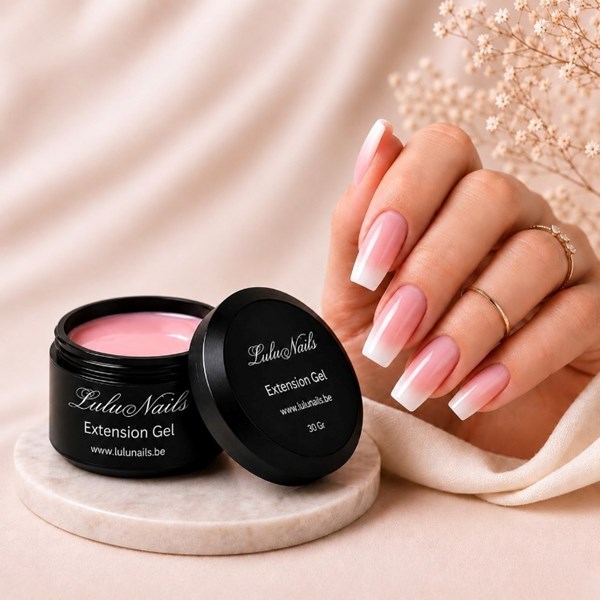
Can you create a Baby Boomer manicure using Popits?
Yes, various techniques can be used to create a Baby Boomer manicure with Acrygel or gel.
A combination of shades such as:
Nude / Pink Milky / White
allows you to create the characteristic gradient.
The LuluNails Acrylgel range currently includes several colours that can be used for different nail-building styles, notably Nude and Milky shades. LuluNails
What shapes can be created with Popits?
The moulds come in various shapes.
For example:
almond, square, ballerina/coffin, oval, Russian almond or other styles.
The choice depends on the desired length and the natural shape of the nail.
However, a very long or technical shape requires greatermastery of the shape.
A Popit does not replace an understanding of:
the apex, the stress zone, the parallels and theaxis.
Do you need to file after a Popit application?
Yes, even though the Popit can reduce the amount of worknecessary.
After removing the mould, check:
the cuticle area, the sides, the free edge, the axis, the underside and the overall shape.
When the application is very neat, filing can be kept to a minimum.
However, ‘Popit’ does not automatically mean ‘no filing at all’.
A small correction is still preferable to an incorrect structure.
How do you remove the excess material from under the Popit?
Before full curing, the excess must be properly controlled according to the material and the protocol.
A large amount of product must not be left under the free edge.
This area must remain clean and proportionate.
Afterpolymerisation, corrections can also be made using a file or a sander if the technique requires it.
LuluNails Nail Files and Bits.
Which lamp should be used for Popits?
The material must be cured using a UV/LED lamp compatible with the product being used.
As the Popit is placed around the gel for part of the curing process, it is particularly important to follow the protocol specific to gel or Acrygel.
Do not arbitrarily reduce the curing time simply because your lamp has a high wattage.
The appropriate curing time depends on the product.
Can you hold the Popit in place during curing?
During the initial setting, it may be necessary to hold the Popit securely in place so that it does not move.
Some professionals use a small lamp to achieve an initial set before full curing.
However, rapid curing is never a substitute for the full polymerisation recommended by the product manufacturer.
The aim is simply to prevent the mould from shifting before final curing.
Why does my Popit come unstuck after a few days?
The problem is not necessarily down to the Popit.
It may be due to the preparation or the bonding system.
In particular, check the preparation of the nail plate, the presence of cuticles, dust, the use of Nail Prep or Primer where the protocol requires it, the base coat used, contact with the skin and the curing process.
If the extension is lifting only near the cuticles, focus your analysis particularly on this area.
Why do my Popit extensions break?
A Popit application is still a proper nail extension.
It must therefore follow a suitable structural design.
An extension can become more fragile when the stress-bearing area is insufficient, when the sides have been tapered too much, when the length is too great in relation to the structure, or following a significant impact.
Simply adding more Acrygel everywhere is not necessarily the solution.
The material must be applied correctly.
Acrylgel or Construction Gel for a long extension?
For a relatively long extension, the stability and rigidity of the material become particularly important.
Acrygel can be a very good option as it remains malleable before curing.
A builder gel can also be used if it is specifically suited to the length and technique.
In all cases, check the exact properties of the product you are using.
Which material should you choose when starting out with Popits?
To learn, I would generally start with a material that is very easy to control.
This is one of the great advantages of Acrylgel/Polygel.
It allows you to take the time to:
position the material, control the amount, create the shape and check the sides.
A highly self-levelling gel may require a quicker application.
Once you have mastered the technique, you can try out different viscosities and determine which one best suits &your working speed.
LuluNails Acrygel for Extensions and Popits
LuluNails currently offers a range of Acrygel / UV/LED Polygel designed for nail strengthening and extensions, comprising several shades such as Natural Nude, Beige Latte Nude, Milky White, Intense White and various colours. LuluNails
Acrygel’s stable texture makes it a particularly interesting range to consider for techniques using Popit moulds.
LuluNails Builder Gel for Extensions
The LuluNails Builder Gel category also offers several gels in 15 g and 30 g sizes, including Milky Natural, Nude Pink and Clear, designed for strengthening, coating and extensions depending on the product code. LuluNails
For Popits, choose only a product whose viscosity and characteristics are suitable for this application.
LuluNails Acrylgel and Gel – HEMA- and TPO-free
The relevant LuluNails ranges are available free from HEMA and TPO.
However, this does not mean that a product is hypoallergenic or that areaction to another ingredient is impossible.
When using UV/LED products, avoid contact between uncured material and the skin, carefully remove any excess before curing, and use a lamp compatible with the product.
Popits Nails: Quick Selection Guide
| Your requirement | Materials to consider |
|---|---|
| First Popit application | Acrylgel / Polygel |
| Material that is easy to control | Acrygel |
| Extensions using a very stable material | Acrygel / specially formulated thick gel |
| Quick application by a professional | Builder Gel with suitable viscosity |
| Coating without extensions | Flexible Builder Gel |
| Long extensions | Acrylgel or suitable builder gel |
| Baby Boomer Popit | Nude/Pink Milky/White |
| Natural build | Nude Acrygel or Nude/Milky gel |
The exact choice must always be checked according to the characteristics of the product used.
FAQ – Popits Nails
What material should be used with Popits?
Acrygel/PolygelAcrygel/Polygel is particularly practical thanks to its stable texture. Some builder gels may also be suitable provided they have the right viscosity.
Can Builder Gel be used with a Popit?
Yes, for certain products. However, a very runny gel will generally be more difficult to control than a more viscous gel.
Acrylgel or Builder Gel: which is easier for a beginner?
AcrylgelAcrygel is often easier to control because it remains stable before curing.
What is the difference between Popit and an American tip?
The Popit is removed after curing. An American tip remains attached the application.
Can you create long nails using Popits?
Yes, but the design, material and length must be correctly managed.
Why is my Acrylgel oozing out of the Popit?
Check, in particular, the amount of product, the size of the Popit and the pressure applied.
Why do I have a bubble in my build-up?
An air pocket may become trapped during application if the material or the Popit is not positioned correctly.
Do I need to file a Popit application?
Precise application can significantly reduce the amount of work required, but corrections to the shape or structure may still be necessary.
Which Acrylgel should you choose for a natural-looking application?
A Nude, Pink or Milky shade generally creates a very natural-looking base.
Can semi-permanent nail varnish be applied to a Popit build?
Yes, provided the build has been carried out correctly and the nails have been prepared according to the system used.
Can you create a Baby Boomer look with Popits?
Yes. The Nude, Pink, Milky and White shades allow for various ombre techniques.
Can a LuluNails Flexible Builder Gel be used for any Popit extension?
No. LuluNails Flexible Builder Gels are primarily designed for tip application and natural-looking short to medium-length extensions. For a Popit extension, only use a product with properties suited to the desired build. LuluNails
Popits, Acrylgel and LuluNails Belgium Construction Gel
Would you like to create nail extensionswith Popits?
Find all the products you need for your nail builds at LuluNails Belgium:
Acrylgel / Polygel – Builder Gel – Builder Gel – Base Coat – Nail Prep – Primer – Top Coat – UV/LED Lamps – Brushes – Files – Buffers – Professional tips.
LuluNails is a Belgian brand specialising in products, equipment and nail care training in Liège, with online ordering and delivery throughout Belgium and Europe.