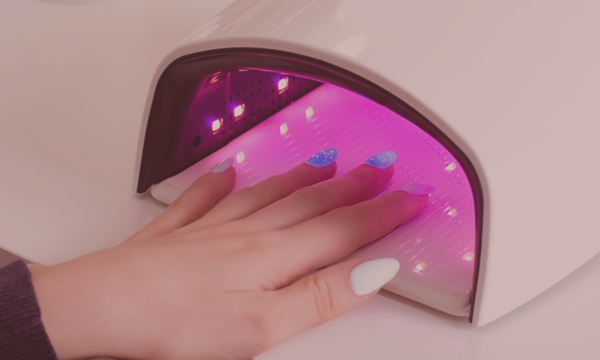
BIAB, Builder Gel in a bottle, Rubber Base or builder gel? Find out the differences between them and which product to choose to strengthen your nails with LuluNails Belgium.
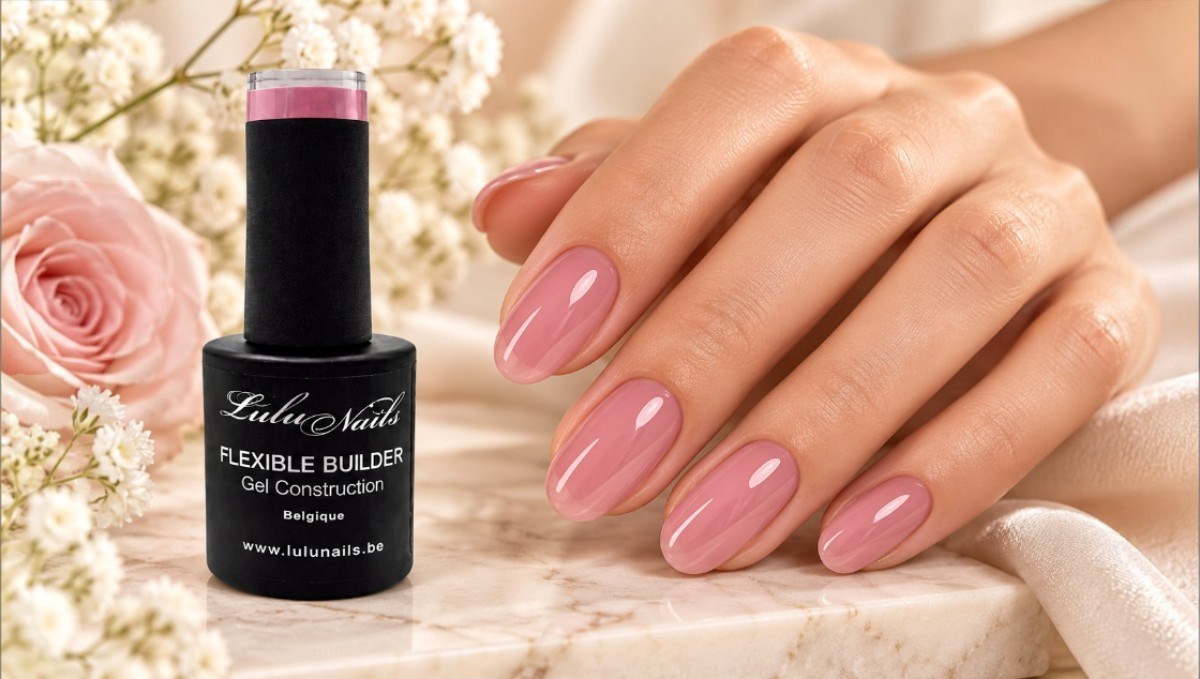
BIAB Nails: What is it? Bottle Builder Gel, Rubber Base or Builder Gel? | LuluNails Belgium
You’re hearing more and more about BIAB for nails, builder gel in a bottle, rubber base or even construction gel, but you’re not quite sure what the difference is?
These products can all be used to strengthen or build nails, but they do not have exactly the same texture, flexibility or uses.
Whether you’re a beginner or a professional nail technician, understanding these differences makes it easier to choose the right product for:
- the natural nail;
- length;
- coating;
- strengthening;
- the apex;
- a nude or milky finish;
- extensions.
In this comprehensive guide, LuluNails Belgium explains in simple terms the difference between BIAB, Builder Gel in a bottle, Flexible Builder Gel, Rubber Base and builder gel in a pot.
What does BIAB mean in relation to nails?
BIAB stands for Builder In A Bottle.
It is a builder gel supplied in a bottle with a built-in brush.
The term BIAB™ refers to a commercial range from The GelBottle Inc. In everyday language, some people nevertheless use “BIAB” to refer more broadly to bottled builder gels.
At LuluNails, we use the following terms:
and
Bottled Builder Gel
to refer to our bottled builder gels.
The concept is very practical: the brush is built directly into the bottle, just like with semi-permanent nail varnish.
What is a bottled Builder Gel?
A Builder Gel in a bottle is a builder gel packaged in a bottle fitted with a brush.
Unlike traditional builder gel in a pot, there is no need to use a separate brush.
It is particularly handy for:
- strengthening the natural nail;
- applying a base coat;
- creating a slight apex;
- correcting minor irregularities;
- working on short and medium-length nails;
- creating nude or milky looks;
- carrying out certain fill-ins;
- work quickly in a salon.
The bottle format also allows for better control over the amount of product when you’vemaster the technique properly.
Builder Gel in a bottle or builder gel in a pot: what’s the difference?
The difference isn’t just down to the packaging.
Builder Gel in a bottle
It is generally useful for:
- natural nails;
- base coats;
- short applications;
- reinforcements;
- natural manicures;
- clients wishing to maintain their natural nail length.
Its built-in brush makes for quick application.
Builder gel in a pot
It generally offers more possibilities for:
- extensions;
- templates;
- more complex designs;
- long shapes;
- structural corrections;
- technical modelling.
The gel is applied using a separate brush, which allows for precise control over the quantity and shape.
Quick summary
Short natural nail → Builder Gel in a bottle
Coating → Flexible Builder Gel
Long extension → Suitable builder gel
Significant shaping → Suitable pot gel
The product must always be chosen based on its actual technical characteristics.
What is the difference between Builder Gel in a bottle and Rubber Base?
This is a very common question.
Both products can be used on natural nails, but they do not serve exactly the same purpose.
Rubber Base
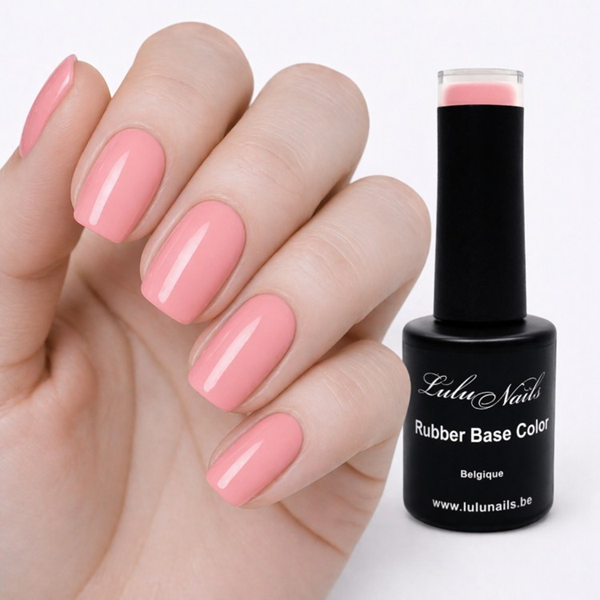
Rubber Base is generally a thicker and more flexible base than a standard Base Coat.
It may be suitable for:
- short nails;
- minor reinforcements;
- slight imperfections;
- natural manicures;
- coloured manicures when using a Rubber Base Colour.
Builder Gel in a bottle
Builder Gel allows for greater control over the structure.
Depending on its formulation, it allows, in particular:
- coating;
- reinforcement;
- apex;
- surface correction;
- moderate-length extensions.
When more structure is required, Builder Gel may therefore be more suitable than a simple Rubber Base.
Rubber Base or Builder Gel: which one to choose?
Strong, short natural nails
A standard Base Coat may sometimes be sufficient for a semi-permanent nail polish application.
Thin or flexible nails
A suitable Rubber Base can provide extra support.
Nails requiring proper reinforcement
A flexible builder gel may be a good option.
Nails requiring building
Choose a suitable builder gel or construction gel.
Long extensions
Opt for a product specifically designed to support the desired shape and length.
The aim is not to choose the thickest product.
You should choose the product suited to the type of nail and the technique used.
What is a Builder Gel coating?
The coating involves strengthening thenatural nail without necessarily extending it.
The product is applied to the natural nail plate to create a suitable structure.
A builder gel treatment allows you to work on, in particular:
- strength;
- shape;
- a slight apex;
- the stress zone;
- minor surface irregularities.
It is particularly useful for people who wish to grow their natural nails whilst maintaining a well-structured manicure.
At LuluNails, the Flexible Builder Gels in bottles are specifically designed for this type of work.
Can you create an apex using a Builder Gel from a bottle?
Yes, provided it is a Builder Gel intended for this purpose.
The apex refers to an integrated reinforcement zone &the structure.
On a short natural nail, the apex can remain very discreet.
The longer the nail, the more carefully the structure must be planned.
A good application must maintain:
- a thin area near the cuticles;
- material distributed correctly;
- adequate reinforcement in the stress zone;
- a proportionate free edge.
Theaim is never to create a large bulge of product.
Self-levelling Builder Gel: what does that mean?
A self-levelling gel has a texture that helps the product spread evenly across the surface of the nail.
This feature can result in:
- a smoother surface;
- faster application;
- fewer corrections;
- a build that is easier to control;
- less filing required once the application is mastered.
However, a self-levelling gel may also continue to spread towards the cuticles if you use too much product or work too slowly.
You must therefore control:
quantity viscosity working time.
No-file builder gel: is it the same thing?
Not exactly.
A self-levelling gel can facilitate a technique known as no-file, but this does not mean that every application will automatically be perfect without correction.
A “no-file” application” application relies primarily on precise application:
- correct quantity;
- well-positioned apex;
- uniform surface;
- controlled parallel lines;
- correct shape before curing.
If the structure has a flaw, it is still best to correct it.
Flexible Builder Gel: why is flexibility important?
Not all natural nails have the same rigidity.
Some nails are:
- thin;
- supple;
- flexible;
- naturally stiffer.
A Flexible Builder Gel better accommodates the movements of certain natural nails than a very rigid gel.
It is particularly suitable for:
- nail wraps;
- short lengths;
- medium lengths;
- natural strengthening.
For long extensions or complex designs, a stiffer gel may be preferable depending on the technique.
Can you create an extension using a bottle of Builder Gel?
It depends on the product.
Some bottle-type Builder Gels are only suitable for:
- strengthening;
- coating;
- minor corrections.
Others may allow for very small extensions.
For a long extension using a template or a complex design, it is generally preferableto use a builder gel specifically designed for this technique.
Therefore, never choose a product based solely on the name ‘Builder Gel’.
Always check:
- flexibility;
- viscosity;
- rigidity;
- recommended use;
- maximum length;
- product instructions.
Builder Gel Clear, Nude, Pink or Milky: which one to choose?
Builder Gel can also be used to create a coloured base directly.
Clear
Clear is transparent.
It is particularly versatile when a colour is to be applied afterwards.
Nude
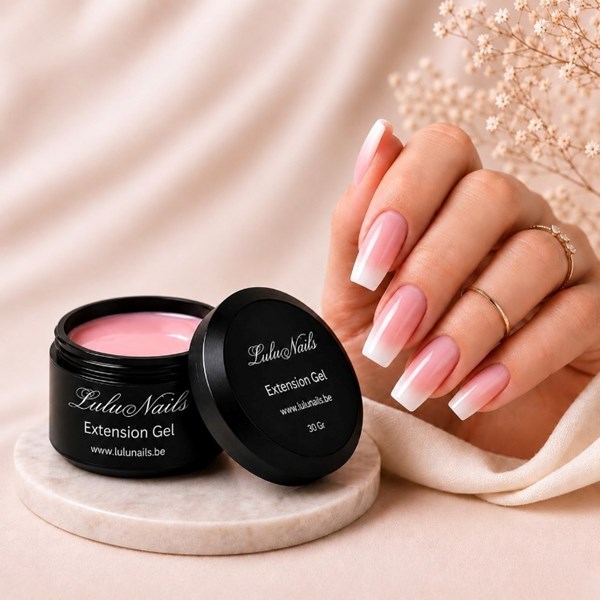
Nude Builder Gel instantly creates a natural-looking base.
It is ideal for:
- Clean Nails;
- natural manicures;
- French manicures;
- elegant designs.
Pink
Pink creates a soft, luminous finish.
It may be suitable for:
- French manicures;
- Baby Boomer;
- natural manicures.
Milky
Milky creates a slightly translucent milky-white effect.
It is particularly popular for:
- Milky Nails;
- Baby Boomer;
- French manicures;
- wedding manicures;
- Clean Nails.
Builder Gel in a bottle semi-permanent nail polish: is this possible?
Yes, provided the products are compatible.
You can build up your nails with Builder Gel and then apply a colour.
Example:
Preparation
→ Nude Builder Gel
→ Bordeaux Semi-Permanent Nail Polish
→ Top Coat
Or simply retain the natural colour of the Builder Gel:
Milky Builder Gel
→ Top Coat
This option is particularly useful in salons, as the same base can then be painted with many different colours.
Builder Gel or semi-permanent nail varnish: what’s the difference?
Semi-permanent nail varnish mainly provides:
colour and finish.
Builder Gel allows for greater focus on:
structure and strengthening.
A standard semi-permanent nail varnish is therefore not intended to replace a builder gel.
Semi-Permanent Nail Polish
Colour.
Builder Gel
Strengthening and structure.
Top Coat
Finish.
Understanding these three roles helps to avoid many mistakes when you’re just starting out.
Which lamp should you use for Builder Gel?
Builder Gel must becured under a UV/LED lamp compatible with the product.
You should not choose a lamp based solely on its wattage.
Curing depends in particular on:
- the product;
- the photoinitiators;
- the lamp;
- the thickness;
- the recommended curing time;
- the position of the hand.
Always adhere to the curing time specified for the product you are using.
If the build is too thick, this must not be compensated for by simply adding a few seconds of lamp time at random.
Why does my Builder Gel run into the cuticles?
Common causes are:
- applying too much;
- the gel is too runny;
- working time too long;
- hand held at an angle;
- poor control of the self-levelling process.
To avoid this problem:
- use a controlled amount;
- keep the cuticles thin;
- check the sides;
- check the profile;
- cure when the structure is correct.
Uncured product must not remain in contact with the skin.
Why is my Builder Gel peeling off?
There may be several reasons for this:
- incorrect preparation;
- cuticles present on the nail plate;
- dust;
- product coming into contact with the skin;
- inappropriate base coat;
- incorrect use of the primer;
- inappropriate layers;
- incorrect polymerisation;
- incompatible lamp.
Simply changing the Builder Gel is therefore not always the solution.
The entire procedure must be analysed.
Can a refill be carried out using a Builder Gel from a bottle?
Yes, provided it is suitable for the system already in place.
However, a refill involves more than just filling in the regrowth.
The following must be checked:
- the existing structure;
- any detachments;
- the apex;
- the length;
- the shape;
- the stability of the material.
New growth gradually pushes the old structure towards the free edge.
It may therefore be necessary to rebalance the structure.
Builder gel for beginners: which one to choose?
When you’re just starting out, it’s generally easier to work with a material that is:
- sufficiently self-levelling;
- but not excessively runny;
- easy to control;
- suitable for short applications.
Start by practising on short nails:
- preparation;
- amount of product;
- coating;
- light apex;
- curing;
- finishing.
You can then gradually move on to more complex designs.
Builder Gel or Acrygel?
These are two different systems.
Builder Gel
It is applied as a gel and can be self-levelling.
Acrygel
Acrygel generally remains much more stable before curing.
It allows the material to be shaped before it is polymerised.
One is not automatically better than the other.
The choice depends in particular on:
- the technique;
- your skill level;
- the length;
- your working speed.
HEMA- and TPO-free Builder Gel by LuluNails Belgium
The LuluNails Flexible Builder Gels are formulated without HEMA or TPO.
They are available in several shades, including:
- Clear;
- Nude;
- Pink;
- Milky;
- Cover.
However, the label HEMA- and TPO-free does not mean that a product is hypoallergenic or that a reaction is impossible.
For all UV/LED products:
- avoid contact with the skin;
- remove any excess before curing;
- follow the instructions;
- use a compatible lamp.
BIAB, Rubber Base or Gel Construction: comparison table
| Product | Main use | Formula | Format |
|---|---|---|---|
| Base Coat | Semi-permanent base | Low | Bottle |
| Rubber Base | Light reinforcement | Flexible | Bottle |
| Builder Gel in a bottle | Coating & strengthening | Medium | Bottle |
| Flexible Builder Gel | Natural nail coating | Flexible | Bottle |
| Construction Gel | Architecture & extension | Heavier | Jar or bottle depending on product |
| Acrygel | Shaping & extensions | Stable | Tube or pot depending on product |
The table serves as a general guide: always check the technical data sheet for the product in question.
Which product should I choose? Quick answer
I just want to apply semi--permanent
Base Coat Gel Polish Top Coat
My nails are thin and I need a bit of strengthening
Rubber Base adapté
I want to keep my natural nails and strengthen them
Flexible Builder Gel
I want to create a slight apex
Builder Gel in a suitable bottle
I want to do a long extension
Builder Gel suitable for extensions
I want a very stable material for shaping
Acrygel may be an option depending on the technique.
FAQ – BIAB, Builder Gel and Rubber Base
Are BIAB and Builder Gel the same thing?
BIAB™ refers to the Builder In A Bottle range from The GelBottle Inc. The term is sometimes used colloquially to refer to bottled builder gel, but not all brands of builder gel are BIAB™.
What is the equivalent at LuluNails?
At LuluNails, look for Flexible Builder Gels / Builder Gels in bottles, designedin particular for coating and strengthening natural nails.
What is the difference between Rubber Base and Builder Gel?
Rubber Base generally provides a lighter reinforcement, whilsta Builder Gel offers more possibilities for creating a proper structure.
Can you apply semi-permanent nail varnish over a Builder Gel?
Yes, provided the products are compatible and the surface has been properly prepared.
Can Builder Gel be left colourless?
Yes. A Nude, Milky or Rose shade can simply be finished with a suitable top coat.
Can Builder Gel be used to extend the nails?
That depends on the product reference.. For a long extension, choose a gel specifically designed for nail building.
Should I start with Builder Gel in a pot or a bottle?
The bottle is very handy for learning the basic coating technique. The pot offers more possibilities for learning more technical builds and extensions.
Does builder gel require- an apex?
The level of structure depends on the length and the application. On a short nail, the curve can be subtle; on a longer extension, thearchitecture becomes more prominent.
Is a Builder Gel necessarily self-levelling?
No. The viscosity andvary depending on the product.
Does ‘HEMA- and TPO-free’ Builder Gel mean it is allergy-free?
No. A formula free from HEMA and TPO does not mean it is hypoallergenic and does not rule out a reaction to other ingredients.
Nail technician training courses in Liège
LuluNails Belgium Flexible Builder Gel
Are you looking for a Builder Gel in a bottle in Belgium to create a gel coating or strengthen your natural nails?
Discover the LuluNails Flexible Builder Gels, available in several natural shades:
Clear – Nude – Pink – Milky – Cover.
The built-in brush allows for easy application for natural looks, nail extensions and strengthening.