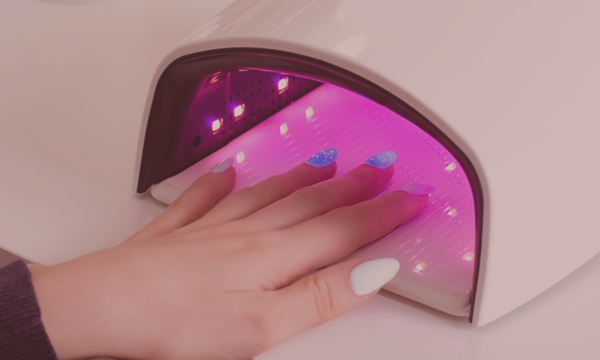
Is your builder gel getting hot under the lamp? Find out why, and learn about the role of thickness, builder gel, the lamp and the Low Heat setting with LuluNails.
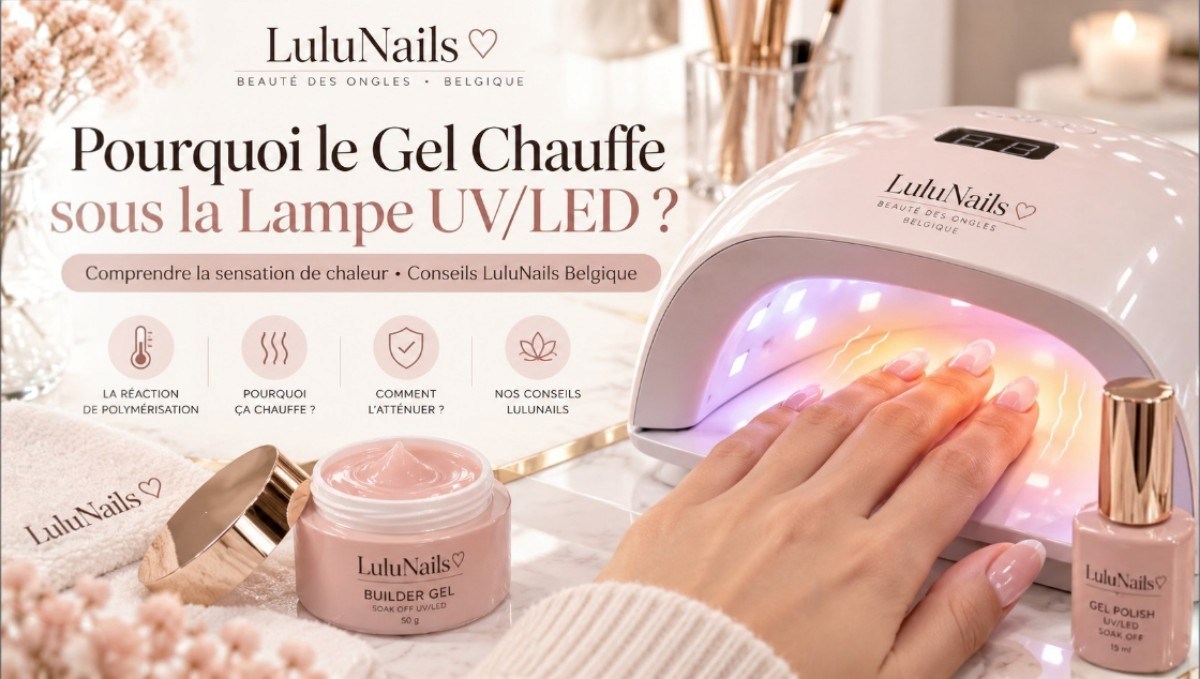
Why Does Construction Gel Heat Up Under the UV/LED Lamp? Causes & Solutions | LuluNails Belgium
Does your build-up gel heat up under the UV/LED lamp during curing?
This sensation can come as a surprise when you’re new to gel nail application. It can also occur with certain builder gels, particularly when the build contains more material.
Why does the gel get warm? Does a more powerful lamp necessarily generate more heat? Is the ‘Low Heat’ setting useful? Can you reduce the time spent under the lamp?
In this guide, LuluNails Belgium explains the main causes of the sensation of heat during polymerisation and the best practices for working correctly with UV/LED gel.
Why does the gel heat up under the lamp?
UV/LED gel does not simply dry like a conventional nail varnish.
Under a compatible lamp, a polymerisation reaction gradually transforms the liquid or mouldable product into a hardened material.
This reaction can generate heat.
The sensation experienced may vary depending on several factors:
- the gel’s formulation;
- the amount of material applied;
- the thickness of the build;
- type of gel;
- lamp used;
- curing method;
- condition and preparation of the natural nail.
A sensation of heat does not therefore automatically mean that the lamp or the gel is faulty.
Why does a builder gel get hotter than a semi-permanent nail varnish?
The amount of material is generally much greater in a gel build.
With semi-permanent polish, you mainly work in thin layers.
With a builder gel, you can create:
- an apex;
- a wrap;
- a stress zone;
- an extension;
- a structural correction.
The amount of gel on the nail may therefore be greater.
Several layers of gel may then produce a more noticeable sensation of heat during polymerisation.
1. A gel layer that is too thick
This is one of the first things to check.
Applying a large amount of Builder Gel in a single go can cause a more pronounced reaction during curing.
The aim is not to apply a lot of gel simply to make the nail automatically stronger.
The material must be distributed according to the required structure.
A well-balanced build generally comprises:
- a thinner area near the cuticles;
- a suitable structure;
- a correctly positioned apex;
- controlled thickness;
- a proportionate free edge.
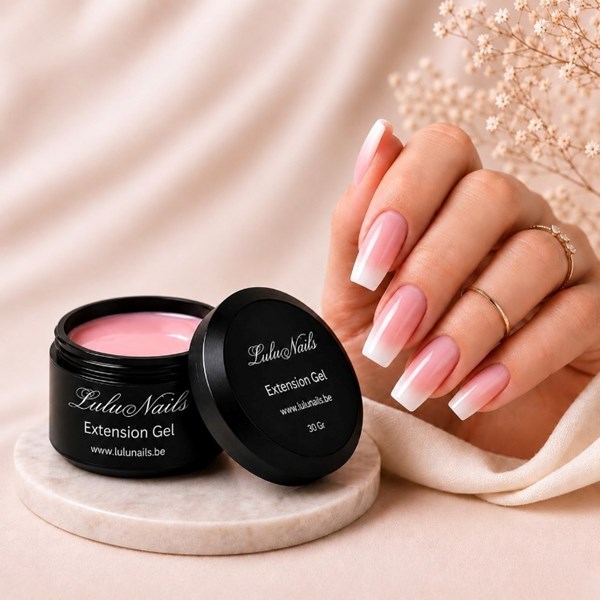
LuluNails Construction & Builder Gel.
2. The formulation of Builder Gel
Not all builder gels react in exactly the same way.
Some are:
- more fluid;
- thicker;
- self-levelling;
- flexible;
- designed for coating;
- intended for larger builds.
The sensation of warmth may therefore vary from one product to another.
This does not mean that a gel which warms slightly is necessarily of poorer quality.
Above all, the product must be used in accordance with its instructions.
3. Self-levelling gel and quantity of material
A self-levelling gel spreads out gradually before curing.
This property can facilitate:
- coating;
- building the apex;
- achieving a smooth surface;
- reducing the need for filing once the technique has been mastered.
However, ‘self-levelling’ does not mean that you should use more product.
Use an amount appropriate to the length and shape of the nail.
Self-levelling gels are already part of the Builder Gel ranges featured in the LuluNails guides. LuluNails
4. Can the UV/LED lamp affect how warm it feels?
Yes, the way the lamp operates can influence how the polymerisation process begins.
But you shouldn’t just look at the wattage.
Catalysis depends in particular on:
- the lamp’s technology;
- its compatibility with the product;
- the distribution of the LEDs;
- the gel application protocol;
- the exposure time;
- the quantity of product.
A lamp advertised as 60W is therefore not automatically « better» than a 36W lamp for every product.
The priority remains the same:
compatible gel compatible lamp correct curing time.
What is the Low Heat mode used for?
Some UV/LED lamps have a Low Heat mode or progressive low-power mode.
This mode generally allows polymerisation to begin more gradually when the product and its protocol are compatible with this function.
This can be particularly useful with certain:
- Builder Gels;
- construction gels;
- coating materials;
- constructions containing more material.
However, the Low Heat mode must not be used to arbitrarily shorten the gel’s curing time.
Always follow the product instructions.
36W or 60W: which wattage should you choose?
It may be tempting to think:
60W = better curing
It’s not quite that simple.
The wattage is a specification of the device, but it alone does not determine:
- the time required;
- compatibility with the gel;
- the quality of the polymerisation;
- the depth of curing.
At LuluNails, some lamps offer several settings to suit different protocols.
The setting must always be chosen according to the product actually used.
Why you should not arbitrarily reduce the curing time
A common mistake is to think:
«My lamp is powerful, so I can cure for a shorter time.»
This line of reasoning can lead to insufficient polymerisation.
A gel may appear hard on the surface without necessarily being properly polymerised throughout its entire thickness.
Therefore, ensure you adhere to:
- the compatible lamp;
- the recommended curing time;
- the intended thickness;
- the manufacturer’s instructions.
Do not simply reduce the curing time from 60 seconds to 30 seconds just because your lamp has a higher wattage.
How can you reduce the sensation of heat when using a builder gel?
Use a controlled amount
Do not apply an excessive amount of Builder Gel in one go.
Build the structure using only the amount actually required.
Avoid making the nails unnecessarily thick
A nail that is too thick is not automatically stronger.
A good structure is more important than a large amount of product.
Use the appropriate mode
If your lamp has a Low Heat mode compatible with your gel, use it in accordance with the recommended protocol.
Check lamp/gel compatibility
A UV/LED lamp is not automatically ideal for all formulations.
Adhere to the recommended curing time
Do not arbitrarily shorten the curing time.
Why can over-aggressive preparation increase discomfort?
Preparation of the natural nail must be carried out in a controlled manner.
Excessive filing of the natural nail plate does not automatically improve adhesion.
On the contrary, it can unnecessarily thin the nail.
During preparation:
- treat the cuticles properly;
- remove any residue from the nail plate;
- only mattify when the protocol requires it;
- avoid filing into the natural nail;
- use the appropriate file or bit.
LuluNails already recommends in its preparation guides that you should not compensate for poor technique by over-working the nail plate. LuluNails
What should you do if the sensation becomes very strong?
A slight sensation of warmth may sometimes occur during the polymerisation of certain gels.
However, a severe burning sensation should not simply be endured.
Stop using the product and check the following in particular:
- the amount of gel;
- the thickness;
- the condition of the natural nail;
- the product used;
- compatibility of the lamp;
- curing protocol.
Do not allow uncured gel to come into direct contact with the skin.
Before continuing, identify what may have caused an excessive reaction.
Builder Gel or Acrygel: which one generates the least heat?
The behaviour of the two products is not identical.
Builder Gel
Builder Gel can be self-levelling and may shift slightly before curing.
In particular, it can be used for:
- coating;
- apex;
- reinforcement;
- extensions, depending on the product.
Acrygel
Acrygel is generally more stable before curing and stays more firmly in place.
It allows the material to be worked for longer before polymerisation.
However, the sensation during curing depends on the formulation and protocol of the product used.
It is therefore incorrect to claim that a particular product range never heats up.
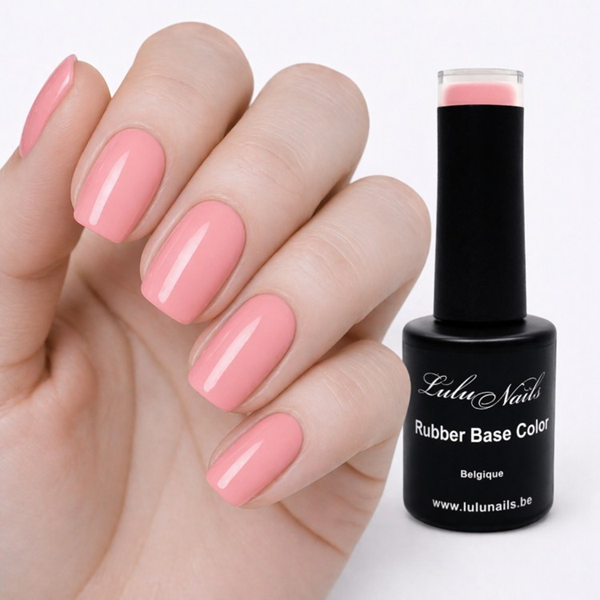
Builder gel or Rubber Base?
The Rubber Base and Builder Gel cater to different needs.
Rubber Base
It can be used for certain relatively light extensions and applications on natural nails, depending on the product.
It allows for a wider range of applications:
- shaping;
- apex;
- structural reinforcement;
- corrections;
- extensions;
- lengths.
The choice should depend on the desired result and not solely on how it feels under the lamp.
How can you tell if the gel has cured properly?
Do not rely solely on the appearance of the surface.
To apply it correctly:
- use a compatible lamp;
- follow the recommended curing time;
- avoid applying the gel too thickly;
- position your hand correctly;
- position your thumb correctly;
- check the condition of your lamp regularly.
Gel that has not polymerised sufficiently must not be compensated for by simply adding a new layer.
Why can the thumb cause problems?
When the hand is placed flat in the lamp, the thumb may sometimes be positioned differently from the other fingers.
Depending on the lamp and the positioning, this can limit its proper exposure.
For certain techniques, it may therefore be preferable to cure the thumb separately so that it is correctly positioned.
The aim is for each nail to be properly cured in accordance with the prescribed protocol.
LuluNails Builder Gel – HEMA- and TPO-free
The LuluNails builder gels in question are available free from HEMA and TPO.
However, this does not mean:
- hypoallergenic;
- free from the risk of a reaction;
- that incorrect curing is harmless.
UV/LED products must always be used correctly.
Avoid contact with the skin and follow the product instructions.
FAQ – Gel that Heats Up Under the Lamp
Is it normal for a builder gel to heat up under the lamp?
A sensation of heat may occur during the polymerisation of certain gels. Its intensity depends, in particular, on the formulation, the amount of product used and the application procedure followed.
Why does my gel get very hot?
A very thick build or a large amount of product can increase the sensation of heat.
Does a 60W lamp get hotter than a 36W lamp?
Not necessarily. Wattage alone is not enough to determine how the product will react. Compatibility, operating mode and protocol are also important.
What is the Low Heat mode for?
It allows for a more gradual increase in power on lamps that offer this function, provided its use is in line with the gel’s protocol.
Can you reduce the time the gel spends under the lamp if it gets hot?
No. Do not arbitrarily reduce the curing time. Follow the product’s recommendations.
Why does Builder Gel get hotter than semi-permanent nail polish?
A Builder Gel build generally contains more material than a thin layer of colour, which can make the reaction more noticeable.
Can Low Heat be used for a builder gel?
Yes, provided the lamp, the gel and their protocol allow for this setting.
Should you remove your hand if you experience a severe burning sensation?
An intense sensation should not simply be endured. Stop the exposure and check the product, its thickness, the preparation and the protocol before continuing.
Discover LuluNails Belgium’s Builder Gels and UV/LED Lamps
For your gel applications, visit LuluNails Belgium:
- Construction Gel;
- Builder Gel;
- Flexible Builder Gel;
- Rubber Base;
- Acrygel;
- UV/LED Lamps;
- Base Coat;
- Top Coat;
- gel brushes;
- files and buffer tips.
LuluNails is a Belgian brand specialising in products, equipment and training courses fornail art in Liège, with online sales in Belgium and across Europe.