Cleaning, disinfection or sterilisation in nail salons: find out the differences and learn how to look after your tools, surfaces and tips with LuluNails Belgium.
Cleaning, Disinfection or Sterilisation in a Nail Salon: What’s the Difference? Hygiene Guide | LuluNails Belgium
Hygiene is an essential part of working in a nail salon.
Between gel dust, product residues, metal tools, buffer bits, work surfaces and reusable accessories, it is important to understand one thing:
cleaning, disinfecting and sterilising are not the same thing.
These three steps serve different purposes.
Good organisation helps to keep your workspace cleaner, maintain your equipment more effectively and adopt more rigorous professional practices.
In this LuluNails Belgium guide, discover the difference between cleaning, disinfection and sterilisation, as well as the best practices to adopt for yournail equipment.
Cleaning, disinfection and sterilisation: the difference in a few seconds
Cleaning
Cleaning is primarily used to remove:
- dust;
- visible residues;
- dirt;
- gel residue;
- products;
- substances present on a surface or tool.
Cleaning is generally the first step.
Disinfection
Disinfection involves using a suitable process or product to reduce orinactivate micro-organisms on the surfaces or equipment concerned.
The product must be used in accordance with its label, dosage and contact time.
Sterilisation
Sterilisation is a specific process aimed at eliminate all micro-organisms, including the most resistant forms.
It requires appropriate equipment and protocols.
The terms ‘disinfection’ and ‘sterilisation’ should therefore not be used as if they meant the same thing.
Why is it necessary to clean before disinfecting?
A common mistake is to apply a disinfectant directly to a tool that is still covered in dust or residue.
However, cleaning is important because it removes substances that may prevent the subsequent treatment from working properly.
So, to summarise:
1. Remove any residue
2. Clean
3. Disinfect according to the equipment and product
4. Dry
5. Tidy away properly
However, the exact procedure depends on the type of tool and the manufacturer’s recommendations.
How should you clean your nail salon workstation?
Between clients, the table can quickly accumulate:
- filing dust;
- gel residue;
- dust from the nail file;
- small bits of waste;
- traces of products.
Step 1 – Remove the waste
Start by removing used consumables:
- lint-free wipes;
- single-use files, if applicable;
- swabs;
- protective covers;
- other waste.
Step 2 – Remove dust
Use a suitable method to remove dust from:
- table ;
- hand rest ;
- lamp ;
- accessories ;
- area around the sander ;
- vacuum cleaner.
A professional nail vacuum cleaner can also help to reduce dust dispersion whilst working.
Step 3 – Clean the surface
Next, clean the table with a product suitable for the surface.
Step 4 – Disinfect where necessary
Use a surface disinfectant intended for this purpose and follow the instructions for use.
Do not mix different chemicals together.
Which disinfectant should be used in a nail salon?
The word ‘disinfectant’ is not enough.
You must check:
- the intended use;
- the type of surface;
- the dosage;
- contact time;
- precautions;
- compatibility with equipment.
In Belgium, biocidal products must be authorised before they can be marketed and used for their intended purposes.
Always read the label carefully.
Important
A surface disinfectant is not automatically suitable for use on hands or skin.
And a product intended for hands is not necessarily suitable for equipment.
Use each product only for its intended purpose.
Cleaning metal tools
Reusable tools such as:
- cuticle pushers;
- tweezers;
- scissors;
- certain nail art tools;
- metal tips;
must be maintained according to their material and intended use.
Step one: remove residue
Dust, gels and other residue must be removed.
Step two: cleaning
Clean the tool using a method suitable for its material.
Step 3: Appropriate treatment
Depending on the material and your professional protocol, then apply the appropriate disinfection method.
Step 4: drying
The instrument must bebe properly dried before storage.
Leaving tools damp can lead to:
- stains;
- corrosion of certain materials;
- premature deterioration.
How do you clean sander pads?
The pads quickly accumulate dust from:
- construction gel;
- Builder Gel ;
- Acrygel ;
- semi-permanent nail varnish ;
- cuticles.
At LuluNails, there is already a comprehensive guide dedicated to their care.
The general principle is:
brush → clean → treat according to the material → dry → store
However, not all bits react in the same way to products and procedures.
Diamond bits
They require thorough cleaning to remove particles trapped between the grains.
Carbide bits
They are often used for removing gel and building materials.
Ceramic bits
They must be handled with care to avoid impact.
LuluNails Professional Nail Files & Bits.
What is an ultrasonic cleaner used for?
An ultrasonic cleaner can facilitate the mechanical cleaning of certain compatible instruments.
Ultrasonic waves helphelp loosen residue from hard-to-reach areas.
This can be particularly useful for:
- compatible tips;
- small metal tools;
- certain reusable instruments.
Please note: ultrasonic cleaning does not automatically mean sterilisation
This is a very important point.
An ultrasonic cleaner is, first and foremost, a cleaning tool.
Placing an instrument in an ultrasonic cleaner does not automatically mean that it is sterilised.
The subsequent treatment required depends on the equipment, its use and the protocol followed.
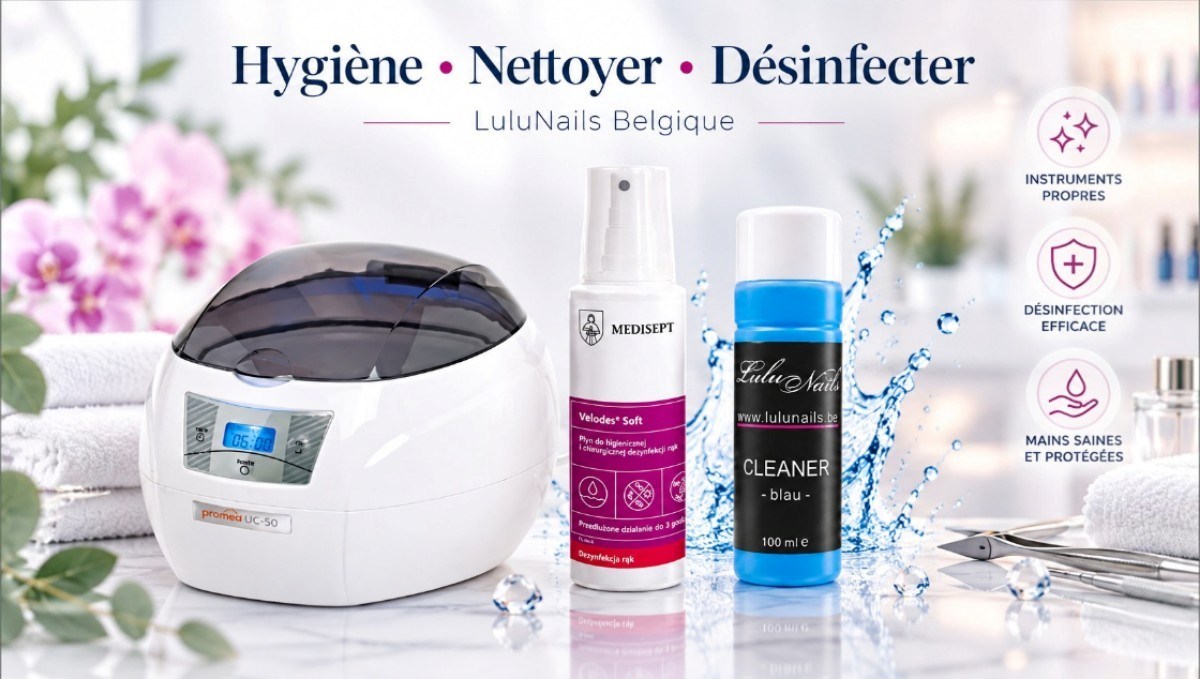
LuluNails currently offers an UC-50 ultrasonic cleaner designed for cleaning nail tools. LuluNails
Should you clean or replace your nail files?
Some accessories are difficult to sanitise properly.
Depending on their design and intended use, nail files, buffers or consumables may be:
- for individual use;
- for single use;
- replaced regularly.
Avoid automatically reusing a consumable on several clients if it is not intended for that purpose.
For a professional, a simple system involves clearly separating:
clean equipment
and
equipment that has already been used
to avoid mixing them up during the day.
Nail cleaner and disinfectant: are they thethe same thing?
No, they should not automatically be considered equivalent.
Nail Cleaner
The nail cleaner is mainly used in the manicure procedure to:
- clean;
- remove grease, depending on the product;
- removing certain residues;
- removing the sticky layer from certain gels where applicable.
Surface disinfectant
A surface disinfectant is specifically designed to treat surfaces in accordance with its authorisation and instructions for use.
You should therefore not automatically substitute one product for another.
Can the same product be used for the table and the hands?
Not automatically.
A product intended to a surface should not be applied to the skin simply because it is labelled ‘disinfectant’.
Products for:
hands
surfaces
equipment
may be intended for different uses.
Always follow the instructions on the label.
How long should a disinfectant be left to work?
The contact time depends on the product.
You should therefore not:
- spray it on;
- wipe it off immediately;
- assume that a few seconds are sufficient.
Read the instructions and follow the contact time specified by the manufacturer.
The dosage must also be followed when dilution is required.
Using more product does not automatically mean better disinfection.
Why separate clean equipment from used equipment?
In a professional setting, it is useful to organise two separate areas.
Clean area
For:
- treated tools;
- clean accessories;
- products;
- equipment ready for use.
Used area
For:
- tools that have just been used;
- accessories to be cleaned;
- bits;
- equipment awaiting processing.
This system prevents a tool that has already been used from being mistakenly stored with clean equipment.
What about gel brushes?
Brushes used for gel require different care to metal instruments.
In particular, they must be protected from:
- dust;
- UV light;
- prolonged exposure to sunlight;
- products that are incompatible with their bristles.
A gel brush should not be treated in exactly the same way as metal tweezers or a sander bit.
After use, remove any excess product according to the product instructions and store it away from light.
LuluNails Gel & Nail Art Brushes.
Nail vacuum and workstation hygiene
When filinga gel or Acrygel application, a lot of dust can be generated.
A nail dust extractor helps to capture some of this dust directly near the work area.
But the vacuum must also be maintained.
Remember to:
- clean its surface;
- maintain its collection system;
- replace or clean the filter, depending on the model;
- regularly remove dust.
A full or poorly maintained vacuum cleaner may become less effective.
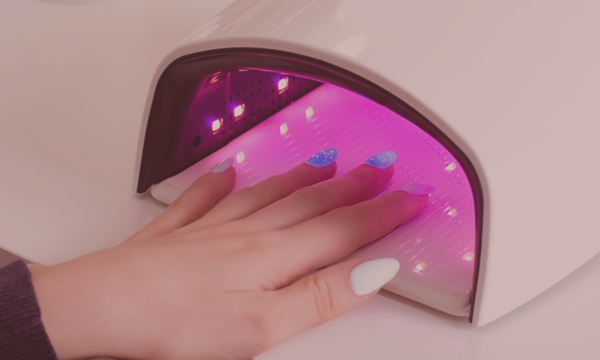
UV/LED lamp: does it need cleaning?
Yes.
A UV/LED lamp is regularly touched by hands and can accumulate:
- dust;
- product residue;
- debris;
- dirt.
Clean the inside and outside using a method suitable for the device.
Avoid using any product that could damage:
- LEDs;
- sensors;
- electronic components;
- plastics.
Never pour liquid directly into the device.
A simple routine between clients
Here is a routine that is easy to remember.
1. Remove used consumables
Dispose of single-use products in the appropriate container.
2. Set aside reusable equipment
Place the tools used in the designated area.
3. Remove any dust
Clean the table and the area around the client.
4. Clean the surface
Remove any visible residue.
5. Disinfect in accordance with the protocol
Use a suitable product and observe the recommended contact time.
6. Prepare clean equipment
Only place equipment on the table that is ready for the next client.
Common hygiene mistakes in nail salons
Disinfecting without cleaning
Visible residues must be removed before the appropriate treatment is carried out.
Confusing cleaner with disinfectant
They do not automatically serve the same purpose.
Using a product without reading the label
Each product has its own instructions for use.
Mixing clean and used tools
Create two clearly separate areas.
Storing instruments whilst they are still damp
Dry instruments thoroughly before storing them.
Believing that ultrasonic cleaning automatically sterilises
Ultrasonic cleaning does not automatically replace a sterilisation protocol.
Reusing all consumables
Some accessories are intended for individual or single use.
Hygiene in LuluNails Nail Technician Training
A trainee nail technician must learn not only how to apply gel or semi-permanent polish, but also how to organise their workstation properly.
At LuluNails in Liège, the training courses cover the various stages of a treatment:
- preparation;
- products;
- equipment;
- filing;
- application;
- finishing;
- workstation maintenance.
Nail Training in Liège at LuluNails.
FAQ – Cleaning and Disinfection in a Nail Salon
What is the difference between cleaning and disinfection?
Cleaning mainly removes dirt and residues. Disinfection uses an appropriate process or product to reduce or inactivate microorganisms on the surfaces or objects in question.
What is the difference between disinfection and sterilisation?
Disinfection and sterilisation are not the same thing. Sterilisation is a more comprehensive process aimed at eliminating all microbial forms and requires a specific protocol.
Should you clean before disinfecting?
Yes. Residues and dirt can reduce the effectiveness of the treatment appliedsubsequently.
Does an ultrasonic cleaner sterilise instruments?
No, not automatically. Itprimarily a cleaning system. It must not be presented as a substitute, on its own, for a sterilisation process.
Can a surface disinfectant be used on the hands?
Only if the product is explicitly intended for this purpose. A surface cleaner must not be applied to the skin as a matter of course.
Can a cleaner be used as a surface disinfectant?
Use each product in accordance with the instructions on its label. A manicure cleaner is not automatically a substitute for an authorised surface disinfectant.
How should clean tools be stored?
Store them in a clean, dry place, separate from equipment that has already been used.
Should sanding machine bits be cleaned after each use?
Reusable bits must be maintained in accordance with their material, their use and the applicable professional protocol.
Cleaning & Hygiene Products from LuluNails Belgium
To organise your workstation, discover the following at LuluNails Belgium:
- surface disinfectants;
- cleaning products;
- Cleaner;
- ultrasonic cleaner;
- cleaning brushes for tips;
- professional accessories;
- nail vacuum cleaners;
- salon and training equipment.