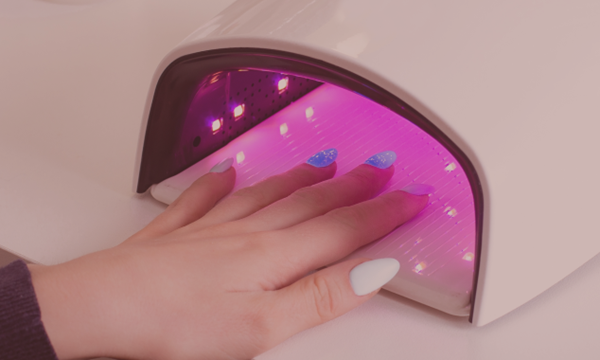
Is your gel or semi-permanent nail polish still sticky after curing under the lamp? Find out the difference between a normal tacky layer, poor curing, Cleaner and No-Wipe Top Coat with LuluNails.
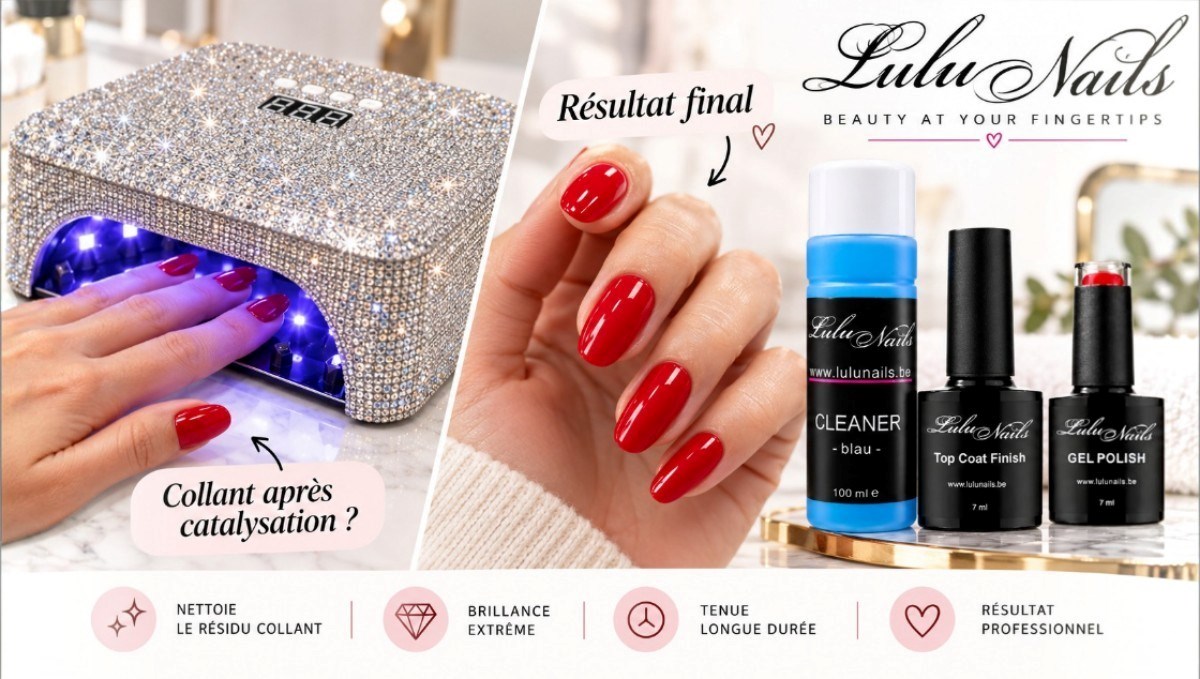
Why does my semi-permanent nail polish or gel remain sticky after curing under the lamp? | LuluNails Belgium
Is your gel or semi-permanent polish still sticky after curing? Find out the difference between a normal tack layer, poor curing, cleaner and no-wipe top coat with LuluNails.
Have you just cured your semi-permanent polish or gel under a UV/LED lamp and the surface still feels sticky to the touch?
Don’t panic straight away.
In some cases, this sticky sensation is perfectly normal: it’s the dispersion layer, also known as the sweat layer or sticky layer.
In other situations, however, a product that is genuinely soft, wrinkled or insufficiently cured may indicate a curing problem.
This is an important distinction.
In this guide, LuluNails Belgium explains how to recognise a normal tacky layer, when to use a Cleaner, why a No-Wipe Top Coat does not work in the same way, and what mistakes can prevent proper polymerisationcuring.
Why does the gel remain sticky after curing under the lamp?
Many UV/LED products may have a slight sticky layer on their surface after curing.
This layer is called:
dispersion layer
inhibition layer
or, more commonly:
sweat layer.
It does not automatically mean that your gel has not cured properly.
Some products are specifically formulated to retain this slightly sticky surface between the different stages of application.
Normal tacky layer or poorly cured gel: how can you tell the difference?
This is the most important question.
Normal tacky layer
The surface may be slightly tacky, but the product underneath is:
hard
stable
with no displacement of material
with no abnormal creases
no liquid areas.
In this case, the sticky layer may simply be part of how the product works.
Poor catalysis
Be more careful if the product:
- remains noticeably soft;
- shifts when you apply light pressure;
- shows creases;
- appears liquid beneath the surface;
- peels off easily;
- sinks in;
- deforms after curing.
In this situation, you should not simply apply Cleaner and assume the problem is solved.
The product may be insufficiently cured.
What is the sweat layer?
The ‘sweat layer’ is a thin residual film present on the surface of certain UV/LED products after polymerisation.
It can appear, in particular, with certain:
Base Coats
semi-permanent polishes
gels
Builder gels
Top Coats with residue.
Depending on the system used, it can help to ensure adhesion between different layers.
This is why you should not automatically clean each layer after every pass under the lamp.
Important
Always follow the exact product protocol.
Some systems require the sticky layer to be left in place between stages.
Others may require a different procedure.
Should the sticky layer be removed between two coats of polish?
Not necessarily.
In a standard application:
Base Coat → colour → second colour → Top Coat
the different coats are generally applied in sequence according to the product’s instructions.
So don’t automatically apply Cleaner after every colour simply because the surface feels sticky.
This may be unnecessary and does not necessarily correspond to the system being used.
Always check the technical data sheet.
When should you use the Cleaner?
The Cleaner is mainly used for cleaning or degreasing, depending on the stage and the protocol.
At LuluNails, the distinction between Cleaner, Nail Prep and Primer is already explained in a dedicated guide: the Cleaner does not serve the samesame function as Nail Prep or Primer.
At the end of a manicure, a Cleaner can be used, in particular, when a top coat leaves a dispersion layer that needs to be removed.
However, this is not the case with all top coats.
Cleaner, Nail Prep or Primer: what’s the difference?
Top Coat with residue or No-Wipe Top Coat?
It’s essential to understand the difference.
Top Coat with a dispersion layer
After curing, it may leave a sticky surface.
The procedure may then require this layer to be removed using a suitable Cleaner.
No-Wipe Top Coat
A No-Wipe Top Coat, also known as a residue-free Top Coat, is designed so that this final degreasing step is not required when it has been correctly applied and cured.
LuluNails currently offers finishes describedsuch as residue-free, and its Top Coat guide already explains this difference. LuluNails
Why does my No Wipe Top Coat remain sticky?
If a genuine No Wipe remains abnormally sticky after following the recommended procedure, you need to identify the cause.
There are several possible reasons.
1. Insufficient curing time
If the product requires a certain amount of time to cure and you remove your hand too soon, polymerisation may be incomplete.
Always adhere to the curing time specified for the product used.
2. Incompatible lamp
Not all lamps necessarily work in the same way with all products.
Compatibility between:
product UV/LED technology duration
is more important than the mere wattage.
3. Layer too thick
Applying a very large amount of product does not result in greater shine.
On the contrary, a layer that is too thick can hinder polymerisation.
Apply an even layer suitable for the product.
4. Incorrect hand position
A finger positioned incorrectly may not absorb the light properly.
The thumb is particularly important.
If it is turned to one side, certain areas may not be exposed as effectively.
5. An ageing or faulty lamp
If a problem arisessuddenly, even though the same procedure worked previously, check the equipment as well.
Why does the semi-permanent polish remain soft afterusing the lamp?
A genuinely soft semi-permanent polish is not the same as a simply tacky layer.
Possible causes include, in particular:
a coat that is too thick
insufficient curing time
an incompatible lamp
incorrect finger positioning
high pigment concentration
a faulty product or lamp.
It is important to identify the cause rather than simply covering up the problem with a top coat.
Why do dark colours require special attention?
Highly pigmented colours may require a particularly controlled application.
This is particularly important with:
Black
Burgundy
Dark red
Midnight blue
Plum
Intense chocolate.
Apply thin, even coats and follow the curing protocol specified in the product information.
A very thick coat of Black should not be considered theequivalent to two thin layers applied correctly.
Why is my nail varnish wrinkling under the lamp?
A product that wrinkles or shrinks after curing under the lamp may indicate several problems.
For example:
a coat that is too thick
too much product
inadequate curing
uneven application
or a problem specific to the product or system.
LuluNails already has a guide dedicated to semi-permanent polish that shrinks, wrinkles or has flaws: create an internal link to this article to build the cluster.
36W, 48W or 60W: does more power mean better curing?
No.
This is a common misconception.
The wattage alone does not determine whether a lamp is perfectly suited to a product.
You must also take into account:
the technology
the product’s compatibility
the light distribution
the protocol
the duration
the thickness applied.
LuluNails explains this principle on its 36W–60W UV/LED Lamp page: a higher wattage does not automatically mean thatthe curing time needs to be reduced. LuluNails
Can I simply cure for twice as long?
Not as a universal rule.
If a product isn’t curing properly, arbitrarily doubling the time isn’t the best way to solve the problem.
Instead, start by checking:
- the exact protocol;
- the lamp used;
- the amount of product;
- the position of your hand;
- compatibility;
- the condition of the equipment.
The key principle is:
follow the system, rather than trying to compensate for a mistake by spending more time.
How do you apply semi-permanent nail varnish correctly?
To minimise curing issues:
Step 1 – Prepare the nail
Treat the cuticles properly and prepare the nail plate according to your protocol.
Step 2 – Base Coat
Apply a controlled layer of Base Coat.
Cure according to the instructions.
Step 3 – First colour coat
Apply a thin, even coat.
Avoid contact with the skin and cuticles.
Cure.
Step 4 – Second coat
If necessary, apply a second thin coat.
Cure again.
Step 5 – Top Coat
Finish with a Top Coat suitable for your system.
Cure according to the manufacturer’s instructions.
Step 6 – Check the type of finish
No Wipe → no degreasing is normally required.
With a dispersion layer → follow the product’s degreasing instructions.
Should you touch the gel to check if it has cured?
It is best to avoid touching a UV/LED product with your fingers unless necessary.
An uncured product must not come into contact with the skin.
Instead, visually assess the application and follow the protocol.
If you have serious doubts about insufficient curing, do not simply carry on with the treatment as if nothing were wrong.
Why should uncured gel be kept away from the skin?
UV/LED products must be applied with precision.
Before placing your hand under the lamp, remove any excess gel from:
the cuticles
the side folds
the skin.
The fact that a range is formulated without HEMA or TPO does not mean that it is hypoallergenic or free from any risk of a reaction.
Proper application and correct polymerisation remain essential.
My Builder Gel remains sticky: is this normal?
It depends on the Builder Gel.
Some gels may retain a dispersion layer.
A slightly sticky surface is therefore not necessarily abnormal.
However, the Builder Gel must not remain:
liquid
soft to the touch
unstable
or deformable even though the curing protocol has been followed.
If this happens, check:
thickness, lamp, curing time and compatibility.
Flexible Builder Gel and Construction Gel .
My Base Coat is still sticky: should I clean it off?
Not necessarily.
In some systems, the surface of the Base Coat remains slightly sticky and the colour is applied straight away.
So don’t automatically use Cleaner.
Follow the instructions for your Base Coat.
The aim is not to achieve a glossy base coat finish: the base coat is primarily intended to create theas specified by the system.
My gel polish is sticky but hard: what should I do?
If the product has polymerised correctly and isis simply a normal dispersion layer:
continue with the application in accordance with the protocol.
If you are at the final stage and the Top Coat used leaves a sticky layer that needs removing:
use the designated Cleaner.
If you are using a No-Wipe Top Coat, do not automatically degrease it.
My Top Coat looks dull after using the Cleaner
This can happen when:
- the product was not meant to be degreased;
- the procedure was not followed;
- cleaning was carried out incorrectly;
- the finish has not been properly cured.
Why is my top coat losing its shine?
Sticky layer, sweat layer and dispersion layer: are they the same thing?
In nail technician terminology, these terms are often used to refer to the tacky surface that some UV/LED products can retain after curing.
You will therefore often see:
sticky layer
sweat layer
dispersion layer
inhibition layer
to describe this phenomenon.
For a customer or a beginner, the most important term to remember is simple:
sticky does not automatically mean poorly cured.
However:
runny or liquid – simply a sweat layer.
Quick guide: what to do?
| Situation | What to do? |
|---|---|
| Hard gel but slightly sticky | Check whether the product has a dispersion layer |
| Top Coat with residue | Degrease if the protocol specifies this |
| Sticky no-wipe top coat | Check curing, lamp, quantity and protocol |
| Soft gel beneath the surface | Do not treat this as a simple tacky layer |
| Wrinkled dark colour | Check thickness and curing |
| A single finger not properly cured | Check position in the lamp |
| Problem with all colours | Check the lamp and procedure |
| Top coat looks dull after using cleaner | Check whether it actually needed to be degreased |
Cleaner or No-Wipe Top Coat: which one to choose?
These are not two competing products.
Cleaner
It is used, in particular, to clean and degrease when the procedure requires it.
No-Wipe Top Coat
It is formulated so that it does not require the removal of a sticky final layer after proper curing.
At LuluNails, the Top Coat category includes glossy, matt and residue-free finishes, whilst the Cleaning category includes Cleaners. LuluNails
LuluNails Semi-Permanent Nail Varnishes, HEMA- and TPO-free
LuluNails Semi-are available in a wide range of colours for creating classic or creative manicures.
For successful application:
thin coats no contact with the skin compatible lamp correct curing time appropriate finish.
The relevant product codes are available HEMA- and TPO-free.
However, this formulation does not mean that a product is hypoallergenic or completely free from the risk of sensitisation.
FAQ – Gel or Semi-Permanent Nail Polish Sticky After Curing
Why does my semi-permanent nail polish remain sticky after curing?
Some products naturally leave a dispersion layer. If the material underneath is properly polymerised, a slightly sticky surface may be normal.
Is it normal for the gel to be sticky after curing under the lamp?
Yes, for some gels. Check the product information sheet to see if it has a dispersion layer.
How can I tell if my gel hasn’t cured properly?
A product that is genuinely soft, runny, crinkled or unstable should not be confused with a simply sticky surface.
Do I need to apply Cleaner after each coat?
No. Only use Cleaner when the protocol specifies it.
Do I need to remove the tacky layer before applying the Top Coat?
Not automatically. Follow the method specified for the products used.
Why does my Top Coat remain sticky?
If it is a dispersion-based Top Coat, this may benormal. If it’s a ‘No Wipe’ Top Coat, check the application instructions, curing time, thickness and the lamp.
Whatis a No-Wipe top coat?
It is a finish designed so that, once properly cured, there is no sticky layer left to remove.
Can I apply Cleaner to a No-Wipe Top Coat?
Normally, a No-Wipe top coat does not require this final degreasing step. Always follow the instructions for the specific product.
Why does black cure poorly?
Highly pigmented colours require careful application. Apply in thin layers and follow the recommended procedure.
Why does my nail varnish wrinkle after curing under the lamp?
A coat that is too thick or a problem withcuring issue can cause this defect.
Will a more powerful lamp always solve the problem?
No. Wattage alone does not determine the quality of polymerisation.
Can a LuluNails UV/LED lamp be used for semi-permanent nail polish?
Yes, for compatible products, provided the settings and curing times specified for each product are followed. The LuluNails range currently includes several professional UV/LED lamps. LuluNails
Should Builder Gel be hard after curing?
The gel must be properly cured according to the instructions. A slightly sticky surface does not mean that the inside should remain soft.
Why does the thumb sometimes cure less effectively?
Its lateral position can reduce proper exposure if it is not positioned correctly under the lamp.
Can products free from HEMA and TPO still cause a reaction?
Yes. HEMA- and TPO-free does not mean hypoallergenic nor does it imply a complete absence of risk from other ingredients.
Where can I buy Cleaner, Top Coat and a UV/LED lamp in Belgium?
LuluNails is a Belgian brand specialising in nail salon products and equipmentnail care. Find semi-permanent nail varnishes, Cleaner, Top Coat, Builder Gel and UV/LED lamps online, with delivery to Belgium and across Europe.