Acrygel or builder gel: which should you choose for nail wraps, extensions, Popits or natural nails? Compare texture, application, filing and level of difficulty with LuluNails Belgium.
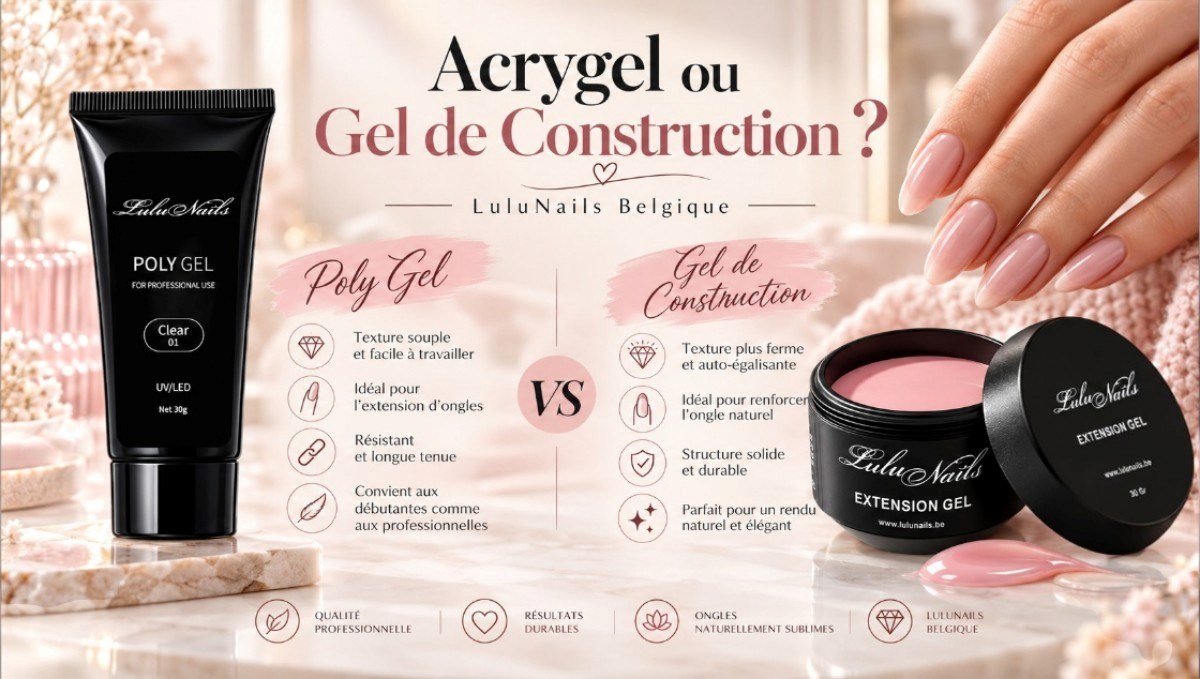
Acrygel or Builder Gel: What’s the Difference and Which One Should You Choose? | LuluNails Belgium
Acrygel or builder gel: which one should you choose for strengthening, extensions, Popits or natural nails? Compare texture, application, filing and level of difficulty with LuluNails Belgium.
Do you want to strengthen or lengthen your nails, but are you torn between Acrygel and Builder Gel?
Both materials can be used to create professional nail builds, extensions and various types of nail modelling, but their behaviour during application is very
Acrygel generally has a dense, stable texture that stays where you place it until curing.
Depending on its formulation and viscosity, builder gel may be more self-levelling and spread gradually across the nail.
So:
Acrygel or Builder Gel to start with?
Which material should you choose for Popits?
Which material for a tip?
Gel or Acrygel for a long extension?
Which is easier to work with in a salon?
In this comprehensive guide, LuluNails Belgium compares the two systems to help you &choose based on your technique, your skill level and the desired result.
What isAcrygel?
Acrygel, also known as hybrid gel or Polygel depending on the product and brand, is a building material that combines certaincharacteristics of gel and acrylic systems.
Its most noticeable characteristic when in use is its very stable texture.
Unlike a relatively runny self-levelling gel, Acrygel generally stays where it is applied.
It can be moved and shaped using a brush and a modelling solution compatible with the product.
The material only sets whenit is polymerised under a compatible lamp.
This stability therefore allows plenty of time to shape the design.
LuluNails currently hasa dedicated category Acryl Gel / Polygel designed specifically for nail builds, extensions and reinforcements.
LuluNails Acryl Gel / Polygel.
What is a Builder Gel?
The Builder Gel, often referred to as Builder Gel, is a UV/LED gel designed to create or reinforce the structure of a nail.
Depending on the product used, it can be used to:
- strengthen the natural nail;
- apply a coating;
- create an apex;
- correct certain shapes;
- carry out an extension;
- work on a template;
- carry out a fill.
However, there are significant differences between gels.
Some are relatively runny and very self-levelling.
Others have a medium viscosity.
Still others remain much more stable.
The LuluNails Gel Construction range currently includes several shades and sizes designed for coating, strengthening and extensions, depending on the product code.
Acrygel or Builder Gel: what is the main?
The difference that is immediately noticeable during application is generally the behaviour of the material.
Acrygel
The material remains very stable.
You apply it, then shape it.
It does not generally tend to self-level quickly.
Builder’s Gel
Depending on its viscosity, the gel may gradually level out and shift.
This can be a great advantage once the technique has been mastered, as the surface can be smoothed with less effort.
However, it also requires monitoring the product before it gets too close to the cuticles.
We can therefore summarise as follows:
Acrygel = highly controlled modelling
Builder’s gel = self-levelling modelling, varying depending on the product
Acrygel vs. Builder Gel table
| Criterion | Acrygel | Builder Gel |
|---|---|---|
| Texture | Dense and stable | Variable |
| Self-levelling | Low or limited | Varies, sometimes significant |
| Runs towards cuticles | Generally minimal if applied correctly | Depends heavily on viscosity |
| Modelling time | Very controllable before curing | Depends on fluidity |
| Coating | Yes, depending on the product | Yes, depending on the product |
| Extension | Yes, depending on the product | Yes, depending on the product |
| Stencil | Yes | Yes |
| Popits | Very practical | Possible with suitable gel |
| Apex | Yes | Yes |
| UV/LED lamp | Depends on product | Depends on product |
| Brush | Yes | Yes for gel in a pot |
| Shaping solution | Generally required/recommended depending on the system | Generally not |
| Beginner | Good control | Good self-levelling |
| Quick to use in the salon | Yes, with practice | Yes, with practice |
So there is no one-size-fits-all winner.
The best productdepends on the service provided.
Acrygel or gel for a beginner?
This is one of the most important questions.
Why Acrygel might be a good choice for beginners
A beginner is often worried that their product:
will run towards the cuticles before she has finished the tip.
Acrygel generally reduces this problem thanks to its stability.
You can take more time to:
- manipulate the material;
- check the shape;
- adjust the sides;
- check the apex;
- correct the length.
You are not constantly working against the-levelling of the product.
Why a self-levelling gel can also be useful
A good self-levelling builder gel can, on the contrary, facilitate thecreation of an even surface.
When you start &master the technique properly:
quantity brush hand positioning possible flipping of the nail curing
gel can allow you to work quickly with relatively little filing.
Conclusion for beginners
If your main difficulty is:
« my gel runs everywhere &"
Acrygel may be worth considering.
If your main difficulty is:
«I find it very difficult to achieve an even surface»
a controllable self-levelling gel might be worth considering.
You should therefore choose based on your working style, not simply on what is most popular.
Which product runs the least?
As a general rule, Acrygel is much more stable before curing<than a runny builder gel.
This is precisely one of the reasons for its popularity.
You can shape several areas without the product immediately running down towards the cuticles.
But be careful:
this does not mean that you can apply any amount of Acrygel.
Proper nail structure is still essential.
Conversely, not all builder gels run heavily.
A high-viscosity gel can also offer a great deal of control.
Self-levelling gel: why is this an advantage?
A self-levelling gel can gradually smooth its own surface.
This is particularly useful for:
- coating;
- filling;
- apexes;
- natural applications;
- reducing filing time.
However, self-levelling does not mean:
‘the gel automatically builds the nail’.
The technician must always check:
- the quantity;
- the stress zone;
- the apex;
- the sides;
- the free edge.
LuluNails currently offers, amongst other products, a Milky White 30 g self-levelling builder gel in its range of builder gels. LuluNails
Acrygel or Gel for a Nail Wrap?
Both can be used to strengthen a natural nail when the product in question is intended for this purpose.
However, the application techniques differ.
Nail Extension with Builder Gel
Particularly suitable when you are looking for:
a smooth surface, a well-defined apex and relatively quick results.
A self-levelling gel is particularly handy in this situation.
Acrygel Coating
Useful when you prefer:
to position the materialwithout it shifting out of place too quickly.
It allows you to shape each area at your own pace.
For a very thin and natural build, there is also a third option:
Flexible Builder Gel in a bottle.
LuluNails Flexible Builder Gel in a Bottle.
Acrygel or Flexible Builder Gel?
These are not exactly the same products.
Flexible Builder Gel
It is particularly useful for:
- natural nails;
- nail wraps;
- reinforcements;
- short or moderate applications;
- Nude Nails;
- Milky Nails.
It also has the advantage of a brush built into the bottle.
Acrygel
It is particularlyparticularly suitable for:
- shaping;
- extensions;
- Popits;
- templates;
- repairs;
- designs requiring a high degree of control.
The choice therefore depends more on the design to be created than on the product’s name.
Acrygel or Gel for Popits?
Here, Acrygel has a significant practical advantage:
its stability.
To use a Popit, the material must be distributed inside the mould before positioning it.
With a stable Acrygel, you can:
- distribute the material;
- adjust its thickness;
- check the cuticle area;
- build up the length;
- then position the Popit.
The product generally stays more easily in the place where you have shaped it.
A builder gel can also be used with Popits provided its viscosity and application method are suitable for this technique.
A very runny gel will require greater control.
Popits Nails: Acrygel or Construction Gel?
Acrygel or Gel for Nail Forms?
Both materials are suitable for use with nail forms when specifically designed for extensions.
Builder’s Gel
The technician applies the gel directly to the nail form and gradually builds up the extension.
Acrygel
The stability of the material allows the shape to be worked on for longer before placing the hand under the lamp.
For an experienced professional, the choice often depends primarily on the preferred working sensation.
Which Material for Long Extensions?
The longer the nails, the more important the structure becomes.
The choice should therefore not be based solely on:
Acrygel or gel?
You must also consider the specific properties of the product used.
Depending on the product code, check in particular:
- rigidity after polymerisation;
- intended use;
- recommended maximum length;
- type of extension;
- viscosity;
- catalysis protocol.
An excellent builder gel designed for extensions may be preferable to an Acrygel that be unsuitable for the desired result, and vice versa.
The precise formulation is more important than the general name of the product family.
Acrygel or gel for very short nails?
On a very short nail requiring a small build-up, a stable material can make the job easier.
Acrygel is therefore a good choice when the technician wants to build up gradually:
a small free edge a controlled structure.
A sufficiently stable builder gel may also be suitable.
In both cases, avoid immediately transforming an extremely short nail into an XXL extension.
A proportionate length is generally a more sensible place to start.
Bitten Nails: Gel, Acrygel, Templates or Tips?
Which Product Should You Use to Repair a Broken Nail?
Acrygel and builder gel can both êbe used in certain repair techniques when the correct product is chosen.
AcrygelAcrygel, in particular, allows a small amount of material to be applied with precision.
A more stable gel can also enable a localised repair.
However, repairs must not be carried out on an injured or painful area.
If the skin or nail has a significant abnormality, do not simply cover the area with a UV/LED product.
Which Product Should You Use to Create an Apex?
Both.
The apex is a structural element of the nail build.
It can be created:
using a builder gel
or
using an acrygel.
The main difference lies in the technique used.
With a self-levelling gel
You apply the product and then use its movement to achieve an even surface.
With an Acrygel
You build up the apex more directly using a brush.
These are two different ways of achieving a balanced structure.
Builder Gel or Acrygel: which requires the least filing?
There is no one-size-fits-all answer.
A perfectly self-levelling builder gel may require very few corrections.
An Acrygel that has been perfectly shaped before curing can also reduce the amount of filing required.
Conversely:
a poorly distributed gel or an Acrygel that is too thick may both require a great deal of work after curingcuring.
The best way to minimise filing is therefore:
build the nails correctly before curing.
Which Product is the Fastest in the Salon?
It depends very much on the technician.
A technician who works daily with a self-&levelling gel can be extremely quick with gel.
Another who has perfect mastery of Acrygel and Popits can save a lot of time with this system.
The right professional product is therefore not necessarily the one that seems easiest to use the first time round.
It is the one that suits your working method, which you repeat every day.
Which Material Heats Up the Least Under the Lamp?
It would be incorrect toclaim that a particular product range never heats up.
The sensation of heat during polymerisation depends in particular on:
- the formulation;
- the thickness;
- the amount of product;
- the lamp;
- the protocol;
- the individual’s sensitivity.
Both Acrygel and Gel de Construction are products that must be used in accordance with their respective protocols.
An excessive amount of product must not be compensated for simply by arbitrarily altering the curing time.
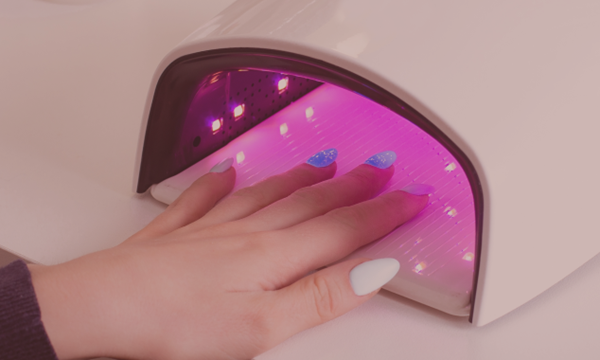
Why does the gel heat up under the UV/LED lamp?
Is a base coat required under Acrygel?
It depends on the system and the product used.
Some protocols require an adhesion base.
Others use a different preparation.
So do not assume that:
“all Acrygels require exactly the same Base Coat”.
Use the protocol corresponding to the relevant LuluNails product.
Is a base coat required under the builder gel?
Same principle.
Depending on the gel and the system:
a Base Coat or an adhesion product may be required before the build.
Always follow the protocol specific to the product reference.
Do not automatically apply multiple layers:
Primer Base Rubber Base Builder
on the assumption that more layers will inevitably result in greater durability.
Each product must have a specific functionspecific function.
What is the difference in texture?
Simply imagine two different behaviours.
Self-levelling builder gel
You apply the material.
It gradually begins to spread out.
You must work whilst taking this movement into account.
Acrygel
You apply the product.
It remains largely in place.
You need to move it deliberately with your brush.
This is probably the easiest difference to understand when you’re unsure which to choose.
Which brush should you use for Acrygel?
Acrygel is generally applied using a suitable brush and a compatible modelling solution.
Some Acrygel tools feature:
a spatula on one side and a brush on the other.
The spatula makes it easier to pick up the material.
The brush is then used to shape it.
Avoid saturating the brush excessively with liquid.
The aim is simply to be able to shape the material correctly in accordance with the procedure used.
Which Brush Should You Use for Builder Gel?
Gel in a pot is g&generally applied using a gel brush.
The size and shape are a matter of technique.
A flat or oval brush allows you to work on different areas of the build in particular.
For a Builder Gel in a bottle, the brush is already included.
This is one of the reasons why these products have become very practical for building nails.
Can semi-permanent nail varnish be applied over Acrygel?
Yes, provided the products are compatible and the build has been prepared in accordance with the system used.
A protocol might, for example, end with:
Acrygel build → surface preparation if necessary → Gel Polish → Top Coat.
This allows you to use the samesame base coat and then completely change the colour during a touch-up.
LuluNails Semi-Permanent Polishes
Can semi-permanent nail varnish be applied over a builder gel?
Yes.
It’s actually a very common combination:
Builder gel → semi-permanent colour → top coat.
You can therefore choose a gel:
Clear, Nude, Pink or Milky
then add any compatible colour on top, depending on the manicure you’re aiming for.
Can you do a French manicure with both?
Yes.
French Manicure on Gel
Build the nails first, then add the French tip.
French Manicure on Acrygel
Same principle.
You can also experiment with the base colours:
Nude Pink White
Milky White
Cover Micro French.
The builder gel alone does not determine the final style.
Can you do a Baby Boomer?
Yes, using both techniques.
The Baby Boomer essentially involves a gradient between:
Pink/Nude and White/Milky.
It can be created using various products, depending on the technique you have mastered.
Acrygel, in particular, allows for very precise shaping of several areas when a full build is carried out.
Acrygel or Gel for Almond, Square, Ballerina or Stiletto shapes?
Both types allow for different shapes when their formulation matches the desired length.
For a technical or very long shape, the technician must have a particular command of:
- axis;
- apex;
- stress zone;
- parallel lines;
- thickness;
- free edge.
It is not the product itself that automatically creates a good structure.
How to Remove Acrygel?
Many Acrygel extensions are mainly removed or reduced by filing, either manually or using a sander, depending on the product and technique.
It is generally unnecessary to remove all the material completely whena refill if the remaining build is sound, well-bonded and compatible with the protocol followed.
You mainly remove what needs correcting and then rebalance the structure.
How to Remove the Builder Gel?
The same principle applies to many construction gels.
They are usually reduced by filing.
A professional sander can speed up the process when used by someone who is properly trained.
However, you should avoid sanding aggressively down to the natural nail plate.
The aim is to control:
speed, bit, pressure and depth.
LuluNails Professional Nail Files
Can you do a refill with Acrygel?
Yes, provided the system used allows it.
As the nails grow:
the natural nail becomes visible near the cuticles and the old structure shifts.
You must then:
check for lifting → reduce the material → prepare for regrowth → rebuild the structure.
A refill does not simply involve filling the small empty space.
Can you do a refill with builder gel?
Yes.
This is one of the classic uses of Builder Gel.
LuluNails already has a comprehensive guide dedicated exclusively to gel nail refills.
Gel Nail Refills: When and How to Do a Touch-up?
Acrygel or Gel for Working with Popits?
If your work involves a lot of Popits, I’d particularly recommendAcrygel.
Its stability makes it much easier to spread the material inside the mould.
However, some high-viscosity gels may also be suitable for Popits.
Acrygel or Gel: which should you buy first?
Opt for Acrygel if you’re looking for:
a very stable material, plenty of time for modelling, use with Popits, or a build that you want to control manually.
Opt for Construction Gel if you’re looking for:
a self-levelling material, quick coating, a classic gel build or different viscosities suited to your technique.
Choose Flexible Builder Gel if you are primarily looking for:
rapid coating on natural nails with the convenience of a bottle.
The best choice is therefore not:
Acrygel versus Gel.
Rather, it is a question of putting together several solutions depending on the services provided.
For a Nail Technician: Why Have Both?
A professional does not perform exactly the same type of application all day long.
One client might ask for:
natural Milky tip application.
Another might ask for:
extensions using Popits.
Yet another might ask for:
Construction gel refill.
Another:
long Acrygel extensions.
Having several textures therefore allows you to choose the product based on the service required, rather thantrying to carry out all applications with a single material.
This is precisely an interesting direction for LuluNails:
Construction Gel Acrygel Flexible Builder Gel.
Three categories with three complementary
Acrygel or LuluNails Construction Gel: Final Comparison Table
| Your needs | Product to consider |
|---|---|
| Self-levelling coating | Suitable builder gel |
| Quick-drying coating in a bottle | Flexible Builder Gel |
| Material that remains very stable | Acrygel |
| Popits | Acrygel / sufficiently stable gel |
| Stencil extension | Suitable gel or Acrygel |
| Highly controlled extension | Acrygel |
| Self-levelling Apex | Suitable gel |
| Work carried out without rushing | Acrygel |
| Classic gel fill | Builder gel |
| Nude / Natural milky | Both |
| French | Both |
| Baby Boomer | Both |
| Beginner worried about runs | Interesting Acrygel |
| Professional used to self-levelling | Very interesting gel |
FAQ – Acrygel or Builder Gel
What is the difference between Acrygel and Builder Gel?
Acrygel generally has a denser and more stable texture. Builder Gel comes in several viscosities and can be more self-levelling.
Acrygel or Gel: which is easier for beginners?
It depends on the difficulty you’re facing.Acrygel offers a great deal of control, whilst a self-levelling gel can make it easier to achieve a smoothsmooth surface.
Which product runs the least?
Acrygel generally remains very stable before curing. A high-viscosity gel can also be very easy to control.
Which product should you choose for Popits?
Acrygel is particularly practical thanks to its stability. Certain sufficiently stable builder gels can also be used if their instructions specify this.
Can you do extensions with builder gel?
Yes, provided the product is designed for extensions.
Can you do extensions with Acrygel?
Yes, provided the Acrygel used is intended for this technique.
Can Acrygel be used on a nail form?
Yes, with a suitable product.
Can semi-permanent top coat be applied over Acrygel?
Yes, provided the products and their application protocols are compatible.
Can semi-permanent polish be applied over builder gel?
Yes. Semi-permanent polish can be used as a colour coat after the builder gel has been properly prepared.
Which one requires the least filing?
This depends more on the quality of the shaping before curing than on the name of the material.
Which product is best for creating an apex?
Both can be used to create an apex. The technique is simply different.
Can you do an Acrygel fill?
Yes, depending on the product and protocol used.
Are Acrygel and Polygelexactly the same?
These terms are often used for closely related families of hybrid products, but the formulations and properties may vary depending on the brand. You should always check the technical data sheet for the product in question.
Acrygel or Rubber Base?
A Rubber Base is generally intended for relatively light reinforcement of the natural nail. Acrygel allows for more shaping and building.
Acrygel or Flexible Builder Gel?
Flexible Builder Gel is particularly useful for coating and short to medium-length natural-looking applications. Acrygel offers greater control for shaping and certain extensions.
Discover Acrygel and LuluNails Belgium Builder Gel
Still can’t decide between Acrygel and Builder Gel?
At LuluNails Belgium, you can choose the material based on your technique rather than on a single trend.
Discover:
Acryl Gel / Polygel
Builder Gel
Flexible Builder Gel
Semi-Permanent Polishes
Base Coat & Top Coat
UV/LED Lamps
Brushes
Popits, Stencils and Capsules
Professional Nail Files and Bits
LuluNails is a Belgian brand specialising in products, equipment and nail technician training courses in Liège, with online sales in Belgium and across Europe.