Very short or bitten nails? Find out which technique to choose: gel build-up, Acrygel, nail forms or tips, and how to create a suitable nail extension.
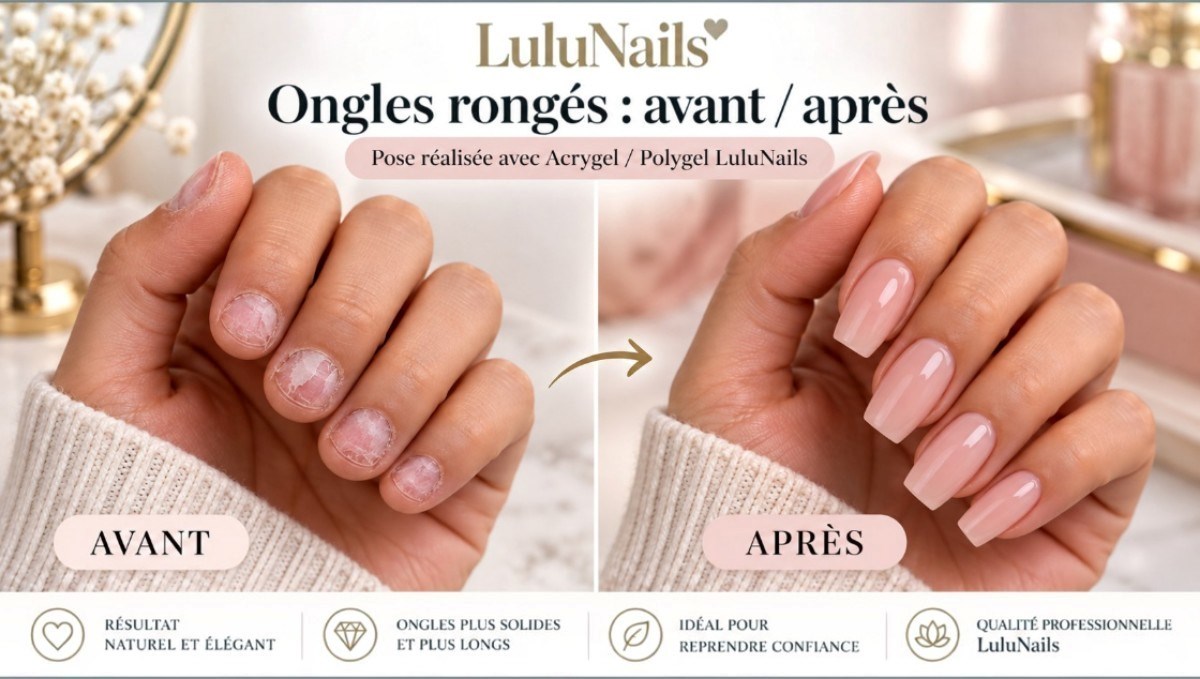
Bitten Nails: Gel, Acrygel, Templates or Tips? How to Rebuild Very Short Nails | LuluNails Belgium
Bitten or very short nails require a different approach to a standard application on a nail that already has a free edge.
When the natural nail plate is short, the aim is not to create a very long extension straight away.
First, you need to consider:
the appropriate length, the extension technique, the stability of the material, the structure and the durability.
Builder gel? Acrygel? Templates? Tips? Builder gel?
Which technique should you choose when the nail is very short?
In this comprehensive guide, LuluNails Belgium explains how to choose a method suitable for bitten nails and why a short, proportionate extension is often preferredto an XXL extension right from the very first application.
Can gel be applied to bitten nails?
Yes, in certain situations, a cosmetic reconstruction can be carried out on very short nails.
However, the condition of the nail and the surrounding skin must first be assessed.
If the area shows:
- an open wound;
- bleeding;
- severe pain;
- marked inflammation;
- a suspicious abnormality of the nail or skin,
you must not simply cover the area with gel or Acrygel.
A cosmetic application must be carried out on a suitable and intact area.
When the nail is simply very short but the surrounding skin is in good condition, several techniques may bebe considered by a suitably trained practitioner.
Why are bitten nails more difficult to work with?
A veryshort nail generally has less surface area available for creating an extension.
The free edge may also be very small, or even almost non-existent.
This makes the following particularly difficult:
- applying the template;
- positioning a tip;
- adding length;
- building the apex;
- managing the stress zone.
It is therefore necessary to work with greater precision.
An extension that is too long in relation to the natural base can create significant leverage and become more difficult to wear.
Which technique should you choose for bitten nails?
The best technique depends on several factors:
| Situation | Technique to consider |
|---|---|
| Very short nail | Short gel or Acrygel extension |
| Very little free edge | Acrygel or adapted template technique |
| Requires a very stable material | Acrygel / Polygel |
| Customised extension | Stencil |
| Nail already slightly pushed back | Suitable construction gel / builder gel |
| Need for quick lengthening | Tips to suit the shape of the nail |
| Natural look | Nude / Milky / Rose Cover |
There is no single technique that is perfect for all nails.
Acrygel: a good option for very short nails?
Acrygel / Polygel can be particularly useful becauseit generally has a stable texture before curing.
Unlike a highly self-levelling gel-levelling gel, the material does not shift rapidly during modelling.
This allows the technician to take more time to:
- position the material;
- create a small extension;
- check the sides;
- shape the free edge;
- gradually build up the structure.
LuluNails already offers a range Acrygel / Polygel designed for strengthening and extensions.
Why start short?
On a severely bitten-down nail, a small extension often makes more sense than a significant length.
The aim of the first application is, above all, to achieve a structure that is:
proportional, stable, comfortable and easy to maintain.
The length can then be adjusted as the nail grows out.
Building Gel for Bite-Nails
The Building Gel can also bebe used when suitable for extensions.
It allows you to work on:
- the structure;
- the apex;
- the stress zone;
- the length;
- shape.
For a very short nail plate, I would opt for a material that is sufficiently controllable rather than an extremely runny gel.
A viscosity that is too runny can be more difficult to control around very short areas.
Self-levelling gel or thick gel?
Both textures can be useful, but not for the same job.
Highly self-levelling gel
It allows you to quickly create a smooth surface.
It is useful for:
- lining;
- minor corrections;
- nails that are already long enough.
However, for very short extensions, an extremely runny gel may require a faster application speed.
More stable gel
It stays more firmly in place where it is applied.
This can make the following easier:
- small extensions;
- extension;
- stress zones;
- precise architecture.
The ideal product therefore depends first and foremost on the technique used.
Templates on bitten nails: is it possible?
Yes, but the technique requires greater skill.
The template is normally placed under the free edge to act as a temporary support for the extension.
On a bitten nail, there is sometimes very little free edge.
Positioning therefore becomes more technically challenging.
A professional can adapt and cut the template correctly so that it follows the shape of the finger and the nail.
Why is the template useful?
It allows you to control:
- the axis;
- the length;
- the sides;
- the shape;
- the construction.
Unlikea pre-formed tip, the technician builds the extension entirely from scratch.
Can tips be used on bitten nails?
Yes, in certain situations, but the tip must be perfectly fitted.
A tip that is too small can put strain on the sides.
A tip that is too large can be difficult to position neatly.
And when the nail is extremely short, the area available for attaching certain standard tips may be reduced.
Tips, stencils or Acrygel: which technique is the easiest?
Tips
They provide immediate length.
They can be a good option when the nail plate allows for secure attachment.
Stencil
It allows you to create a completely personalised extension.
However, it requires greater technical skill.
Acrygel
It allows you to shape the material at your leisure before curing.
Its stability is particularly useful whenyou need to precisely rebuild a small area.
For a beginner
I wouldn’t recommend starting straight away on very bitten-down nails.
It’s better to practise on standard nails first:
preparation → extension → shaping → apex → filing → filling.
Very short nails then represent an additional technical challenge.
Why should you avoid a very long extension from the very first application?
This is one of the most significant mistakes.
A very short natural nail offers relatively little surface area compared to an XXL extension.
The longer the extension, the greater the leverage effect caused by an impact on the tip of the nail.
A short or medium-length initial reconstruction is generally a more sensible option.
For example:
short oval shape
short rounded square
short almond
rather than a very long stiletto.
The LuluNails extension guide recommends creating a proportionate extension on very short or bitten nailsthan going straight for very long lengths. LuluNails
Which shape should you choose for bitten nails?
To start with, I’d go for relatively simple shapes.
Short oval
This helps to visually soften the appearance of the hand.
Rounded square
Practical for everyday wear and easy to maintain.
Short almond
Possible once sufficient length has been achieved.
Best avoided at first
A very long and very pointed shape can be more difficult to wear and to balance.
The initial aim should bebe:
proportion, stability and aesthetics.
What length should you choose?
A short to medium-length reconstruction offers several advantages:
- less leverage;
- lower risk of impact;
- easier to adapt to;
- easier maintenance;
- a more natural transition as the nails grow out.
You can then gradually increase the length at subsequent appointments if the natural structure and the application allow it.
How do you prepare a very short nail?
Preparation must be precise without being aggressive.
1. Assess the condition of the nail
The area must be suitable for a cosmetic treatment.
2. Treat the cuticles
Carefully remove any dead skin from the nail plate.
3. Gently prepare the surface
Do not thin the natural nail excessively.
4. Remove dust
The nail plate must be clean.
5. Use Nail Prep / Primer if the procedure requires it
Do not automatically apply several products simply with the aim ofachieve better adhesion.
Each product must be used according to its specific purpose.
Cleaner, Nail Prep or LuluNails Primer.
Do you need to file a bitten nail a lot?
No.
A very short natural nail does not need to be&nrsquo;&be thinned down any further.
Filing is used to prepare the surface correctly according to the protocol, but it must never involve aggressive abrasion of the nail plate.
The durability of the application depends in particular on:
- the preparation;
- the adhesion;
- the construction;
- the architecture;
- the length.
Not because the natural nail has been cut back excessively.
Which colour should you choose after the reconstruction?
Natural shades look particularly good on a short reconstruction.
Milky
For a clean, luminous finish.
Nude Pink
To match the natural colour of the nail.
Pink Cover
To further conceal certain colour irregularities.
Nude Beige
For a warmer, natural-looking manicure.
French
When the build is sufficiently balanced.
LuluNails offers several gels and Builder Gels in the shades Milky, Rose Nude, Cover and Nude, allowing the colour to be incorporated directly into the build depending on the product used. LuluNails
Builder Gel or Construction Gel?
The difference is significant.
Builder Gel in a bottle
Very handy for:
- coating;
- strengthening;
- natural nails;
- light apex;
- short applications.
Construction Gel
Best suited when you need to:
- create a genuine extension;
- work more on the nail’s structure;
- add length;
- reinforce an area under significant stress.
On an extremely short nail requiring reconstruction, a suitable Building Gel or Acrygel may therefore be a better option than simply coating it with Builder Gel.
Rubber Base: is it sufficient for severely bitten nails?
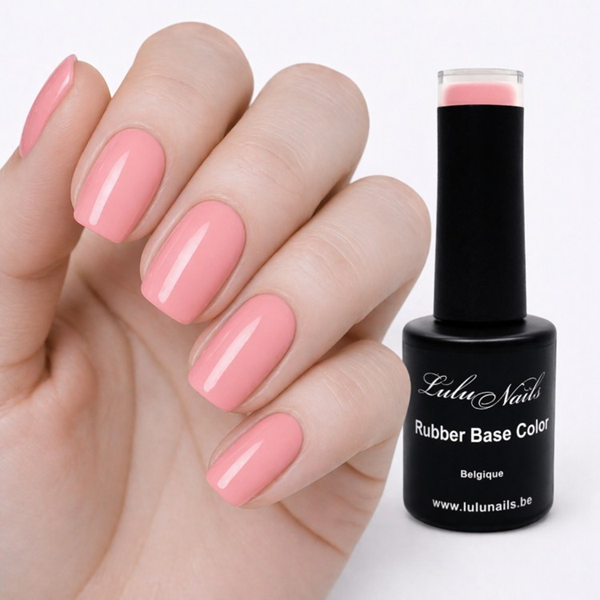
Rubber Base can be useful for slightly strengthening a natural nail.
However, it is not necessarily the ideal product for creating a proper extension.
It is more suited to:
- minor reinforcement;
- natural nails;
- short applications;
- minor imperfections.
When you need to build up a significant amount of length, it is better to use a material specificallyspecifically designed for nail extension.
Why might the application come unstuck?
There are many possible causes:
- inadequate preparation;
- small flakes of skin still present;
- product on the skin;
- dust;
- inappropriate structure;
- extensions that are too long;
- poor polymerisation;
- impact;
- incompatibility between products.
With a bitten nail, the small surface area of the nail plate available can make every mistake more visible.
It is therefore essential to follow the entire procedure meticulously.
Why does the extension break?
A break is different from a lift.
An extension may break when:
- the stress zone is too thin;
- the apex is poorly positioned;
- the extension is too long;
- the sides are too thin;
- the build-up is too thin;
- a significant impact occurs.
Applying large amounts of gel everywhere is not the solution.
The material must be distributed correctly.
Why do my gel nails crack or break?
Can you create a Baby Boomer look on reconstructed bitten nails?
Yes, provided the reconstruction has been carried out correctly.
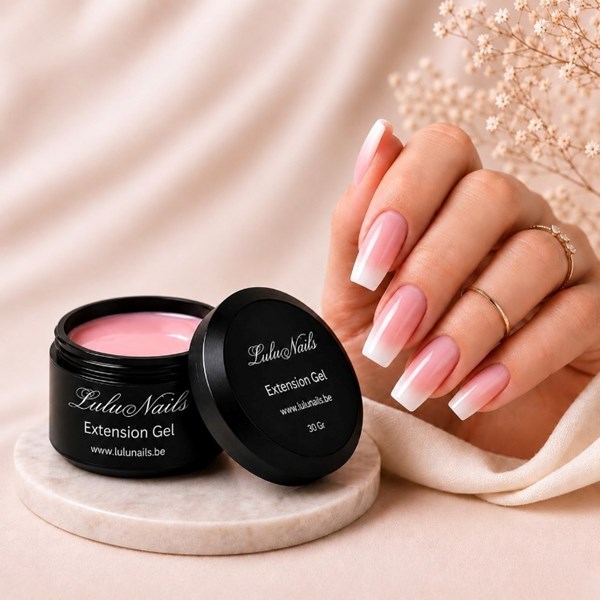
Once the shape has been created, the Baby Boomer can be achieved using:
Nude Pink Milky / White
or with products suitedto the chosen technique.
On a short extension, a soft Baby Boomer can give a particularly natural result.
Can we do a French manicure?
Yes.
A subtle French manicure can even create the illusion of greater length.
For a small extension:
Nude / Rose Cover base White Micro French
can produce an elegant result without weighing down the manicure.
How do you maintain the set as the nails grow out?
The initial set is just one stage.
Natural regrowth will gradually alter the balance of the nail’s structure.
You will therefore need to monitor:
- the regrowth area;
- the apex;
- any lifting;
- the length;
- the shape.
When refilling, the existing material must be checked and the structure rebalanced.
Can you grow your natural nails under gel?
The natural nail continues to grow beneath the gel.
Over the course of your appointments, it therefore becomes possible to achieve greater and greater natural length.
The strategy may evolve:
short reconstruction to begin with
→ toppings
→ gradual increase in natural length
→ eventually Builder Gel coating when artificial extensions are no longer as necessary.
What technique should be used for someone who has started biting their nails again?
A cosmetic application does not automatically cure the habit of nail-biting.
It is also important to avoid creating a length that is so uncomfortable for the person that they are constantly fiddling with the extensions.
A short, comfortable length may be easier to wear.
If the person continually damages the skin or the nail, it is best not to apply multiple layers of cosmetic extensions to a damaged area.
What equipment is needed?
For a professional nail reconstruction, the equipment required depends on the technique used.
You may need, in particular:
- Construction gel or Acrygel;
- templates or tips;
- a brush;
- Nail Prep;
- Primer if necessary;
- Suitable base coat;
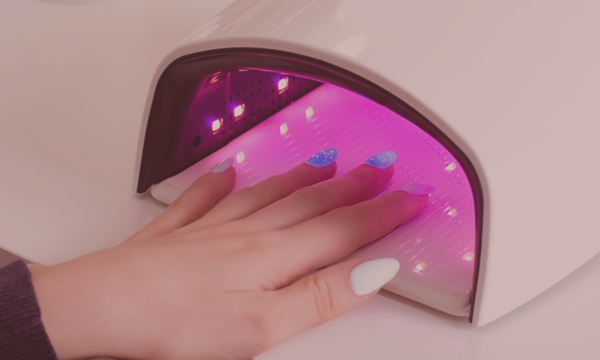
- compatible UV/LED lamp;
- files;
- buffer ;
- Top Coat ;
- semi-permanent polish if a colour is being added.
A nail file may also be useful for a properly trained professional.
LuluNails Builder Gel for Very Short Nails
The LuluNails Builder Gel category includes various UV/LED gels designed for strengthening, coating and extensions, depending on the product code. LuluNails
Natural colours such as:
Milky Natural
Nude Pink
Cover Pink
Nude
are particularly useful when you want to rebuild a nail whilst immediately achieving an aesthetically pleasing base.
LuluNails Acrygel for Reconstruction and Extensions
Acrygel / Polygel allows you to work with a stable, mouldable material.
It can be particularly useful when the technician wants enough time to create a small extension before curing.
After building the nail, it can be finished with:
Top Coat
or:
Semi-Permanent Nail Polish Top Coat.
HEMA- and TPO-free: what does this mean?
The relevant LuluNails ranges are described as HEMA- and TPO-free.
However, this does not mean:
hypoallergenic
or
free from the risk of a reaction.
As with any UV/LED product, avoid contact with the skin and remove any excess product before curing.
Proper curing with a compatible lamp is also essential.
Table: Which Technique Should You Choose for a Bitten Nail?
| Situation | Option to consider |
|---|---|
| Very short nail | Acrygel / Gel Build-up |
| Very little free edge | Short reconstruction |
| Needs checking | Acrygel |
| Customised extension | Template |
| Slightly longer nails | Tips possible depending on shape |
| After several regrowths | Builder Gel / Strengthening |
| Natural-looking result | Nude / Milky / Cover |
| First reconstruction | Short to medium length |
FAQ – Bite Nails and Reconstruction
Can gel be applied to bitten nails?
Yes, provided the condition of the nail and skin allows for a cosmetic procedure. An area that is injured, painful or has an abnormality must not simply be covered over.
Which gel should I choose for bitten nails?
A material suitable for nail extension and which can be sufficiently controlled may be preferable whenan extension is required.
Acrygel or gel on bitten nails?
Acrygel offers great stability during shaping. Construction gel also allowscreate structure when used for extensions.
Can a nail form be applied to very short nails?
Yes, but it requires greater technical skill as the free edge may be very short.
Can nail tips be used?
Yes, in some cases, provided the tip can be properly fitted and secured.
What length should I choose?
A shorter length is generally easier to balance for a first-time nail extension.
Can we create an almond shape?
Yes, but a short almond shape is often more proportionate to begin with than a very long extension.
Why is my application coming off on bitten nails?
Check, in particular, the preparation, adhesion, product on the skin, length, structure and curing.
Builder Gel or Rubber Base?
For simple regrowth or a base coat, these products can be useful. For a major reconstruction, a builder gel may be more suitable.
Can we do a Baby Boomer?
Yes, once the structure has been created correctly.
Can you do a French manicure?
Yes. A Micro French can even make the nails appear longer.
Can natural nails grow underneath the gel?
Yes, the natural nail continues to grow. Fill-ups then allow the extension to be gradually rebalanced.
Rebuilding Very Short Nails with LuluNails Belgium
For your nail reconstruction and extension techniques, visit LuluNails Belgium:
Builder Gel
Acrygel / Polygel
Capsules & Tips
Nail Prep & Primer
Base Coat
Top Coat
UV/LED Lamps
Nail Files
LuluNails also runs a salon and training business in Liège; its services page states, in particular, that nail modelling is used for various types of manicures, including bitten nails. LuluNails