Are your gel nails cracking at the sides or breaking at the free edge? Find out the causes: the apex, the stress zone, thickness, filing and Builder Gel.
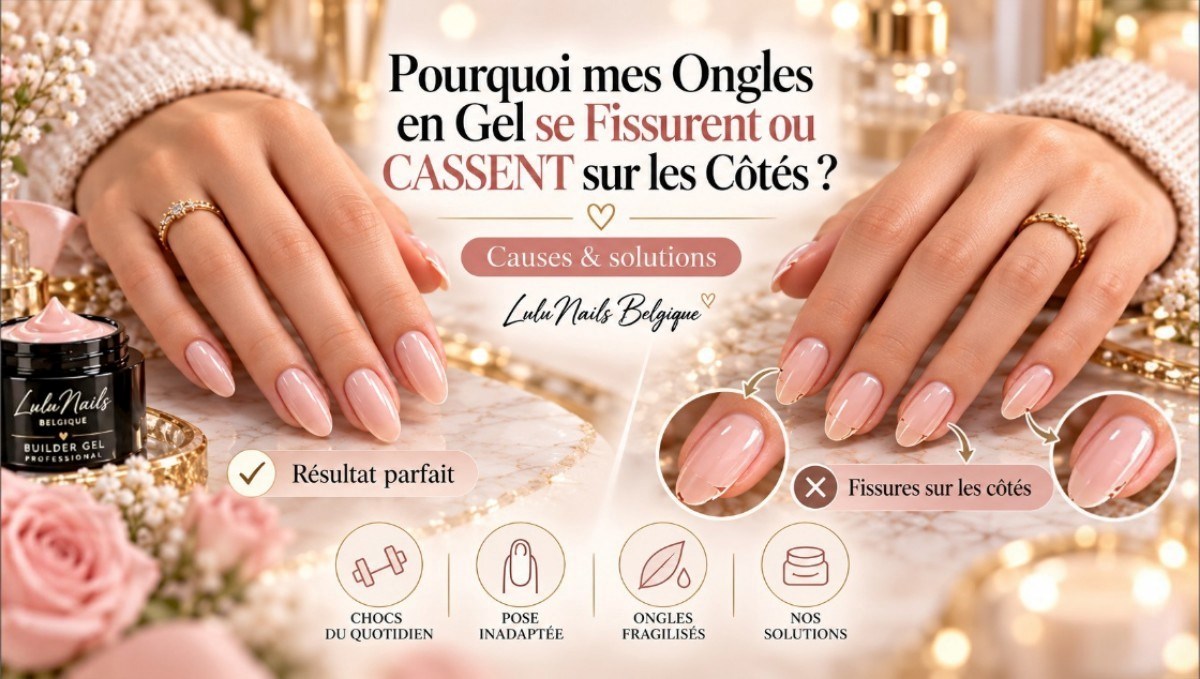
Why do my gel nails crack or break at the sides? Causes & Solutions | LuluNails Belgium
Is your gel nail cracking at the side, breaking at the free edge or developing a small crack a few days after application?
This problem does not automatically mean that the gel used is poor quality.
A crack may be linked to several factors: architecture, apex, stress zone, length, thickness, filing, choice of builder gel, curing or impact to the nail.
A strong application therefore depends on the entire system and not just the amount of gel used.
In this guide, LuluNails Belgium explains the main causes of cracks and breaks in gel applications and how to improve your build.
Why can a gel nail break?
A gel nail has to withstand the stresses of everyday life.
When you pick up an object, open a box, type on a keyboard or accidentally bump your nail, some of the pressure is transferred to the nail extension.
A correctly constructed gel nail aims to distribute these stresses across:
- the apex;
- the stress zone;
- the sides;
- the free edge;
- the length of the nail.
A weakness in any of these areas can lead to a crack.
1. The stress zone is not sufficiently reinforced
The stress zone is an important part of the structure.
It is situated in the area that bears the brunt of the stress when the nail is under pressure.
If this area is too thin in relation to the length of the nail, the nail may become more vulnerable.
The problem often manifests as:
- a lateral crack;
- a small break on one side;
- a break at the free edge;
- a crack that extends and breaks following an impact.
However, the aim is not to create an extremely thick nail.
Above all, the material must be positioned correctly.
2. The apex is incorrectly positioned
The apex should not simply be a large lump of gel.
It forms part of the structure, and its position depends in particular on the length and shape of the nail.<
LuluNails already has a comprehensive guide dedicated to creating theapex using Builder Gel. LuluNails
An apex:
- too flat;
- too far forward;
- too far back;
- excessively thick;
can throw the nail build off balance, both visually and structurally.
For a short set, the apex can remain relatively discreet.
The longer the nails, the more carefully the structure must be controlled.
3. The sides have been filed down too much
This is a common mistake.
When aiming for a very slim shape, it can be tempting to file the sides down heavily.
But removing too much material can weaken the sides.
This can be particularly noticeable on:
- almond;
- coffin;
- ballerina;
- square;
- long extensions.
Filing should correct the shape without removing the necessary structure.
Take care when filing beneath the nail
Attempting to file the underside of the free edge too finely can also weaken the structure.
The result must remain proportionate to the length and type of gel used.
4. The extension is too long for the nail structure
A very long extension exerts greater leverage on the structure than a short nail.
This means that one cannot simply:
take a short design → add a lot of length → retain exactly the samedistribution of material.
The longer the extension, the more important it becomes to control:
- apex;
- stress zone;
- axis;
- parallels;
- free edge;
- thickness.
This is also why learning the architecture is essential before creating very long shapes.
5. The Builder Gel is too thin for the technique being used
Not all Builder Gels have exactly the same characteristics.
Some products are particularly suitable for:
- coating;
- natural nails;
- short applications;
- reinforcement.
Others are designed to allow for more building or certain extensions.
The LuluNails Builder Gel currently comprises several UV/LED gels intended for coating, strengthening and extensions, depending on the product codes and their application protocols. LuluNails
Before carrying out a long extension, please check that the product you are using is actually intended for this technique.
Rigid Builder Gel or Flexible Builder Gel?
These products may meet different needs.
It can bebe particularly useful for:
- coating;
- natural nails;
- short applications;
- strengthening;
- natural manicures.
Builder gel
Depending on its formulation, it can allow for more structural work:
- apex;
- extension;
- template;
- capsules;
- architecture.
There is no single universal product that is ideal for all clients and all lengths.
The product must be suited to the natural nail, the length and the technique used.
6. The nail is too thin at the sides
Aiming for a verynatural-looking application is a good thing.
But natural does not mean extremely thin everywhere.
Different areas of the nail do notnecessarily require the same amount of material.
A well-balanced build must retain:
- a relatively thin cuticle area;
- a clean transition;
- appropriate reinforcement in the stress zone;
- a proportionate free edge.
The aim is to avoid both:
unnecessarily thick nails
as well as
a build-up that is too thin and brittle.
7. Inadequate curing can weaken the application
A UV/LED gel must be cured in accordance with the product’s protocol.
Several factors can influence this stage:
- an incompatible lamp;
- insufficient curing time;
- excessive thickness;
- incorrect hand position;
- incorrectly positioned thumb;
- excessive layer thickness.
Do not arbitrarily reduce the curing time simply because your lamp has a higher wattage.
A nail build must be carried out using a compatible UV/LED lamp and in accordance with the gel’s specific instructions.
8. A crack and lifting are not the same thing
It is important to distinguish between the two.
Lifting
The product gradually separates from the natural nail.
Possible causes may be linked in particular to:
- preparation;
- cuticles;
- adhesion;
- product on the skin;
- procedure;
- polymerisation.
Crack
The material itself shows a break or a fracture line.
In this case, the following should be checked more thoroughly:
- structure;
- stress zone;
- thickness;
- length;
- impact;
- product used.
An installation may also exhibit both problems simultaneously.
9. Impacts remain a significant cause
Even a correctly applied set is not indestructible.
A significant impact can break:
- a natural nail;
- a Builder Gel;
- a gel extension;
- a tip;
- an Acrygel.
Nails must not be used as tools for:
- open packaging;
- peel off objects;
- scrape surfaces;
- open tins.
The longer the extension, the greater the leverage created by an impact.
10. Poorly fitted tip or cap
When fitting using tips or caps, size and positioning are essential.
A cap that is too small can create lateral stress.
A poorly positioned tip can also result in an extension that is:
- misaligned;
- too high;
- too low.
LuluNails already has a guide dedicated to the differences between capsules, tips, stencils and the American method. LuluNails
Capsules, Tips, Stencils or American Manicure
Why does my nail always break in the same place?
Whena client returns regularly with a break in exactly the same place, it’s worth taking a closer look at the application rather than simply adding more gel.
Check the following in particular:
The nail’s axis
Is the build correctly aligned?
Theapex
Is it suited to the length?
The sides
Have they been tapered too much?
The length
Is it suited to the client’s lifestyle and natural nail?
The product
Is it suitable for this technique?
Daily habits
Does the same finger regularly suffer the sameimpact?
This analysis often helps to identify the cause more precisely.
Should you apply much more gel to prevent breakage?
No.
Thicker does not automatically mean stronger.
Adding a huge amount of material can result in:
- a heavy manicure;
- an unbalanced shape;
- poor aesthetics;
- more difficult curing when the thickness becomes excessive.
The priority must be the correct distribution of the material.
This is also what LuluNails explains in its current content dedicated to the apex andarchitecture. LuluNails
What should you do if a crack appears?
A crack should not simply be hidden under a new coat of colour.
First, you need to determine:
- where the crack is located;
- whether the material is still stable;
- whether the natural nail is affected;
- whether there is any lifting;
- whether the area is painful.
A damaged nail extension must be properly assessed and corrected depending on the situation.
If the natural nail is injured or painful
Do not simply continue to cover the area with gel.
Pain, injury, bleeding or any abnormality of the nail requires greater caution and must not be concealedwith a cosmetic product.
How can you minimise breakage when applying a gel build?
Here is a simple method to remember.
1. Examine the natural nail
Before choosing a technique.
2. Choose a realistic length
Especially for a beginner.
3. Use a suitable gel
Coating, strengthening or extension do not always require exactly the same type of product.
4. Build the structure
Check the apex and stress zone.
5. Check the sides
They must be clean but not unnecessarily weakened.
6. Check the profile
Also check the side of the nail.
7. Cure correctly
Use a compatible lamp.
8. File with precision
Adjust the shape without removing the entire structure.
9. Finish with colour
You can then apply a LuluNails semi-permanent nail varnish.
10. Apply the top coat
To achieve the desired finish.
What kind of structure for a short nail?
A short application generally requires less structure than a very long extension.
For a short build-up, the aim may be:
- to strengthen the natural nail;
- to maintain a slender appearance;
- to create a slight apex if necessary;
- to avoid excessive thickness.
A bottled builder gel can be particularly useful for short extensions and applications when it is suited to the nail in question. LuluNails has already published a comprehensive guide on this technique. LuluNails
What structure should be used for long extensions?
The longer the nails, the more carefully the build must be planned.
In particular, you need to check:
- axis;
- apex;
- stress zone;
- parallel lines;
- free edge;
- final shape.
For a beginner, it is often better to master short and medium lengths first before moving on to longer extensions.
LuluNails Construction Gel, HEMA- and TPO-free
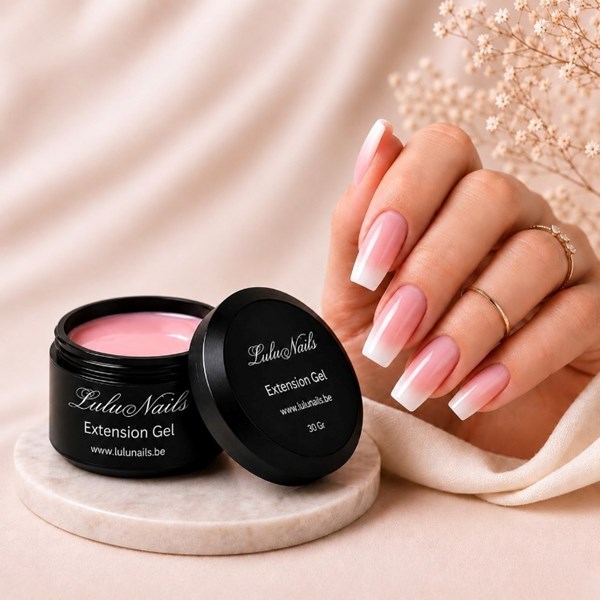
The Construction Gel / LuluNails Builder Gel is currently marketed as comprising HEMA- and TPO-free UV/LED gels, available in several shades such as Milky Natural, Nude Pink, Cover Pink, Caramel Nude and Clear. LuluNails
However, the statement ‘HEMA- and TPO-free’ does not mean that the product is hypoallergenic or that there is no risk of a reaction.
When using UV/LED products:
- avoid contact between uncured gel and the skin;
- remove any excess gel;
- use a compatible lamp;
- follow the product instructions.
FAQ – Gel Nails That Break
Why does my gel crack at thetips?
A lateral crack can be caused by an area that is too thin, excessive filing, insufficient structure for the length, or impact.
Why do my extensions break at the free edge?
Check the length, thickness, structure, the product chosen and the daily stresses the extension is subjected to.
Can an apex that is too small cause breakage?
A structure that is not sufficiently adapted to the length can create a more vulnerable area. The apex must be shaped according to the construction used.
Should I apply a very thick layer of Builder Gel?
No. The aim is to apply the material correctly, not to create excessive thickness.
Why does my gel break but not lift off?
A crack mainly affects the structure of the gel, whereas lifting is more a case of a loss of adhesion between the different surfaces.
Can a crack be repaired with Top Coat?
Top Coat is not a substitute for structural repair. You must first examine the crack and the stability of the nail build.
Should I use Builder Gel or Rubber Base to prevent breakage?
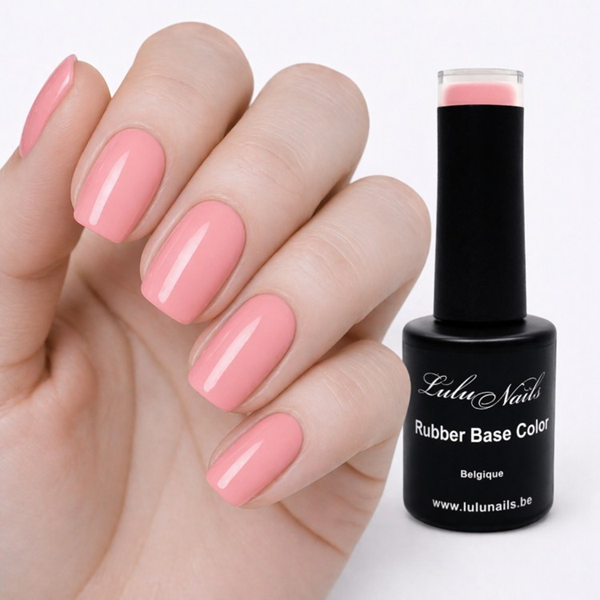
The choice depends on the nail and the required structure. A Rubber Base generally provides lighter reinforcement, whilsta Builder Gel allows for greater control over the nail shape.
Why does a tip crack?
The length, the shape, the positioning, an impact or a weakened tip can all contribute to the problem. LuluNails also covers this point in its guide to tips, extensions and templates. LuluNails
Discover LuluNails Belgium’s Builder Gels
For your nail wraps, reinforcements and extensions, discover the range:
Builder Gel – Flexible Builder Gel – Rubber Base – Acrygel – Base Coat – Top Coat – Semi-Permanent Polishes – UV/LED Lamps – Files – Tips.
LuluNails is a Belgian brand specialisingspecialising in nail care products, equipment and training in Liège, with online sales in Belgium and across Europe. The current Builder Gel range is specificallyspecifically at coating, strengthening and extensions. LuluNails