White nail varnish that turns yellow, Milky that gets stained, or nude that changes colour? Find out the causes and solutions with LuluNails Belgium.

Why Does My Semi-Permanent Nail Polish Change Colour, Turn Yellow or Become Stained? | LuluNails Belgium
Is your semi-permanent nail varnish changing colour after a few days, is your white turning slightly yellow, or is your nude manicure becoming stained?
This phenomenon can occur with different colours, but it is often more noticeable with light shades such as white, Milky, nude, beige or pale pink.
The colour itself isn’t always to blame. Top coat, daily exposure, certain external pigments, curing, or even the products your hands come into contact with can all influence thefinal appearance.
In this guide, LuluNails Belgium explains the main causes and the solutions to try before completely reapplying your manicure.
Why might a semi-permanent nail varnish change colour?
After application, several factors can alter the appearance of the finish:
- contact with external pigments;
- household products;
- hair dye;
- make-up;
- highly pigmented spices;
- tobacco or smoke;
- prolonged exposure to the sun;
- top coat;
- incorrect curing;
- surface contamination.
The problem is often particularly noticeable on very light colours.
A slight change in shade on a ‘Milky’ colour will naturally be easier to spot than on a very dark burgundy.
1. Why can white nail varnish turn yellow?
White is a particularly demanding colour.
On a white surface, even the slightest variation becomes immediately visible.
A white semi-permanent nail varnish that turns yellow may be affected by several factors.
Contact with colouring products
Certain products can leave pigments on the finish:
- hair dye;
- make-up;
- foundation;
- self-tanner;
- spices;
- highly pigmented foods;
- professional products.
The change may therefore mainly affect the Top Coat, and not necessarily the colour underneath.
2. Why do Milky nails appear to stain more easily?
The colours Milky White and milky white are generally soft and luminous.
As they are light in colour, even slight external discolouration becomes very noticeable.
A Milky manicure may, for example, show:
- slightly yellowish areas;
- small spots;
- differences between different fingers;
- discolouration mainly at the tips.
If only certain areas are affected, first consider the activities you carry out with your hands.
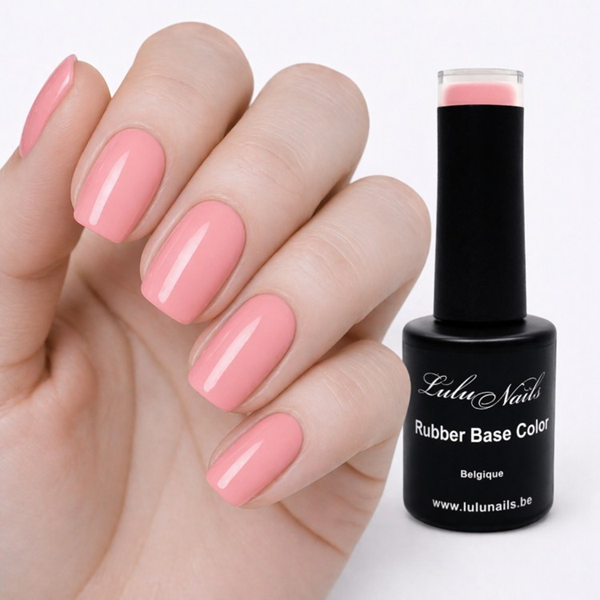
Milky LuluNails Semi-Permanent Nail Varnishes.
3. Can the top coat affect the colour?
Yes.
The top coat is the final layer exposed to your environment.
It is therefore in direct contact with:
- water;
- household cleaning products;
- pigments;
- dust;
- make-up;
- rubbing.
A high-quality, properly cured finish helps to protect the colour, but no coating worn on a daily basis is completely isolated from its environment.
At LuluNails, we offer a range of finishes, including glossy, high-gloss and matt. We’ve also already published a guide on choosing the right top coat. LuluNails
LuluNails Top Coat & Base Coat.
4. Can poor curing affect the result?
Incorrect curing can affect the finish of a UV/LED product.
Several factors need to be checked:
- a compatible lamp;
- the correct curing time;
- sufficiently thin coats;
- correct positioning of the hand;
- product compatible with the system used.
Don’t simply assume that:
a more powerful lamp means the curing time is halved.
Follow the recommendations specific to the product.
LuluNails already points out in its guides that a coat that is too thick can lead to unevenness or incorrect curing. LuluNails
5. Why might a nude colour look different after a few days?
Nude colours contain different undertones:
- pink;
- beige;
- peach;
- caramel;
- brown;
- Milky.
Lighting alone can alter how the same colour is perceived.
A nude shade may appear:
- more pink in natural light;
- more beige under warm lighting;
- cooler under certain LEDs.
It is therefore important to distinguish between a genuine colour change and a simple visual variation caused by the lighting.
To compare properly, look at your nails in natural light.
6. Household products: can they dull or stain the finish?
Hands are exposed to various products on a daily basis.
Frequent contact with:
- cleaning products;
- household products;
- chemicals;
- dyes;
can gradually affect the appearance of a manicure.
When handling household cleaning products, use suitable gloves.
This also protects your hands and minimises direct contact between your manicure and these products.
7. Hair colouring: be careful with pigments
This is a particularly easy case to spot.
Someone is having a manicure:
Milky, nude or French
then applies hair colour without gloves.
The pigments can settle on the surface of the top coat and temporarily or permanently alter its appearance.
The problem may then be particularly noticeable:
- near the free edge;
- on the thumb;
- on the index finger;
- on the fingers used to handle the product.
Wear suitable gloves when applying hair colour.
8. Can spices stain a top coat?
Certain strongly coloured substances may leave visible marks on a very light finish.
This is particularly likely to happen when repeatedly handling highly pigmented ingredients.
This can be particularly noticeable on:
white, milky or very light nude shades.
Before concluding that the nail varnish has changed formulation, check whether the change affects:
all your nails
or only:
the fingers that have come into contact with a pigment.
9. Why do only one or two nails change colour?
This is a very useful clue.
If the whole manicure changes colour uniformly, check:
- Top Coat;
- lamp;
- protocol;
- overall exposure.
However, when only the thumb and index finger are stained, an external factor is often to blame.
Ask yourself:
What have those fingers been handling?
This is often more useful than immediately applying a new coat of colour.
10. Highly pigmented polish: why apply thin coats?
With semi-permanent polish, opacity should not be achieved by using a large amount of product in a single coat.
The generally preferred method is:
1st thin coat → cure
then
a second thin coat → cure
LuluNails already recommends this approach in its guide on nail varnishes that shrink or wrinkle. LuluNails
In particular, an excessively thick coat may:
- wrinkle;
- shift;
- create unevenness;
- complicate the curing process.
How can you prevent semi-permanent nail varnish from staining?
Choose a suitable top coat
Finish the manicure with the top coat that matches the desired result.
Cure properly
Follow the product instructions.
Avoid contact with the skin
Uncured product must not remain on the cuticles or the side folds.
Wear gloves where necessary
Particularly for:
- cleaning;
- hair colouring;
- work involving pigments;
- professional products.
Clean up spills promptly
When coloured material is deposited on the surface, avoid leaving it there unnecessarily for a long period.
Only use a method that is compatible with the finish.
Can a stained top coat be cleaned?
It depends on the nature of the stain and the product used.
A surface mark can sometimes be removed with a product suitable for manicures.
However, avoid using the following at random:
- strong solvents;
- harsh household cleaning products;
- abrasive products.
These can themselves alter the finish.
If the surface is genuinely damaged, a professional repair may be preferable.
Can you simply reapply a top coat?
Not automatically.
Before applying a new coat, identify the cause.
If the surface is:
- dirty;
- oily;
- damaged;
- contaminated;
simply applying a top coat on top is not a good solution.
The surface must be prepared in accordance with the protocol for the system being used.
Why is my white French manicure turning yellow?
A French manicure makes colour variations particularly noticeable.
The white tip may appear less bright due to:
- external pigments;
- a patchy finish;
- wear and tear;
- daily exposure;
- poor polymerisation.
Start by determining whether the problem actually affects the white or just the top coat.
Why might the Matte Top Coat look dirtier?
A matt finish reflects less light than a glossy finish.
Some superficial marks may therefore appear differently.
On shades such as:
- white;
- nude;
- beige;
- Milky;
a matt finish often requires more daily care.
If your priority is a very luminous effect, opt for a glossy finish instead.
What should you do if a nail varnish actually changes colour immediately after curing under the lamp?
If the diff&eacut;appears immediately after curing, check:
- the colour before curing;
- the thickness of the coat;
- the lamp used;
- the curing time;
- the top coat;
- product compatibility.
Also test the colour on a colour chart before application.
This allows you to compare:
colour before curing → cured colour → colour after Top Coat.
This method is particularly useful in salons.
How should you store your semi-permanent nail polishes?
UV/LED products must be stored correctly.
In particular, avoid leaving the bottles:
- in direct sunlight;
- directly in front of a switched-on UV/LED lamp;
- open unnecessarily whilst working;
- exposed to excessive heat.
Whilst applying the polish, close the bottles when you are not using them.
Do not place the bottles directly in the lamp’s beam.
LuluNails Semi-Permanent Polishes – HEMA- and TPO-free
LuluNails semi-permanent nail polishes are presented in the range as HEMA- and TPO-free. LuluNails
However, this does not mean that they are hypoallergenic or that a reaction to another ingredient is impossible.
For correct use:
- avoid contact with the skin;
- remove any excess product before curing;
- use a compatible lamp;
- adhere to the specified curing times;
- apply in thin layers.
FAQ – Colour-Changing Semi-Permanent Nail Polish
Why is my white polish turning yellow?
Check the top coat, the curing process and any contact with pigments or external products. On white, even a slight variation is particularly noticeable.
Why does my Milky polish get stained?
Very light shades make external pigments much more visible than dark colours.
Can hair dye stain my nails?
Yes, pigments can settle on the finish. Wear suitable gloves when handling it.
Why do only two nails change colour?
This may indicate localised contact with a product or pigment rather than a problem affecting the entire application.
Can the Top Coat turn yellow?
The finish may be affected by its environment or the application process. If the problem occurs immediately after curing, also check the lamp and the application.
Can stained semi-permanent nail varnish be cleaned?
Superficial dirt can sometimes be removed using a suitable method. However, avoid solvents or abrasive products not intended for manicures.
Why does my nude colour seem to change depending on where I look at it?
Lighting can significantly alter the perception of nude shades. Compare the colour in natural light.
How can I avoid staining my white nails?
A good finish and wearing gloves when handling highly pigmented products can minimise contact that might stain the surface.
Nail training in Liège
Discover LuluNails Belgium’s semi-permanent nail polishes
Find a wide selection at LuluNails Belgium of:
- semi-permanent nail polishes;
- Milky colours;
- nude;
- pink;
- red;
- burgundy;
- chocolate;
- white;
- Cat Eye;
- Base Coat;
- Rubber Base;
- Top Coat;
- UV/LED lamps.