Is your semi-permanent nail polish shrinking, developing gaps, ripples or creases after curing? Find out the causes, solutions and tips from LuluNails Belgium
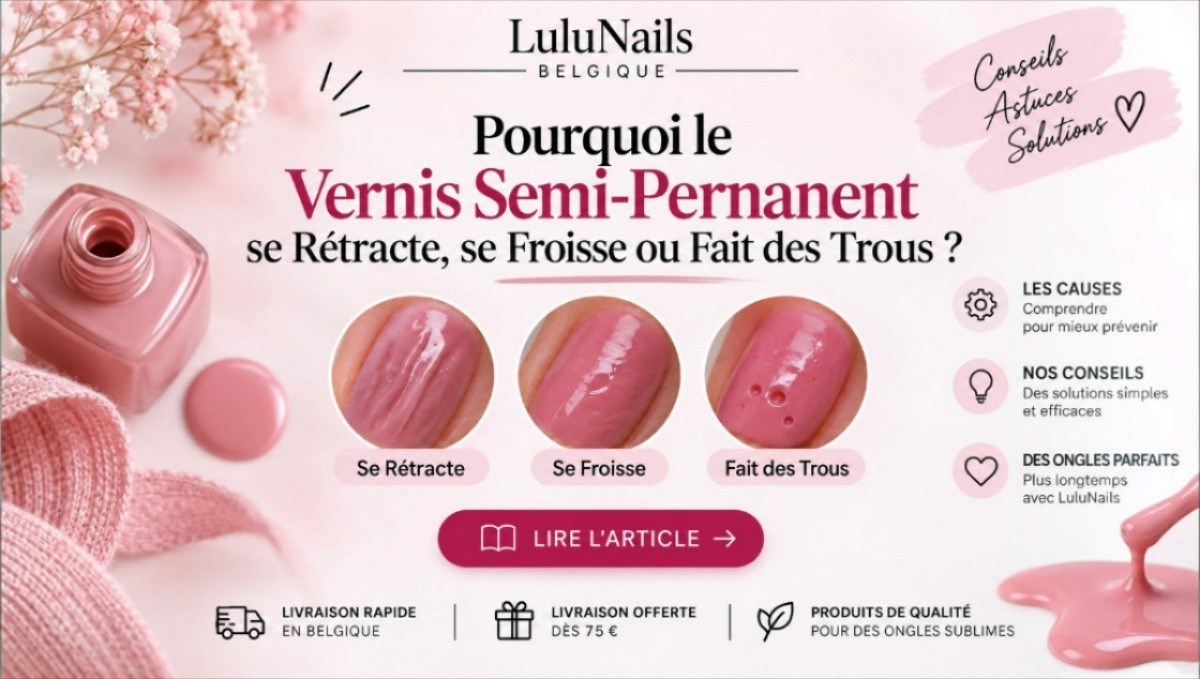
Why Does Semi-Permanent Nail Polish Shrink, Crease or Develop Holes? | LuluNails Belgium
Is your semi-permanent-polish is shrinking on the nail, leaving small holes, wrinkling under the lamp or becoming uneven after curing?
This problem can occur just as easily for a beginner as for an experienced nail technician.
In most cases, simply adding another layer of colour is not enough.
You need to identify when the fault occurs:
- immediately after theapplication;
- a few seconds before curing;
- whilst under the lamp;
- after curing;
- only on certain colours;
- only on certain fingers.
Nail preparation, oily residues, the amount of product used, compatibility between the Base Coat and the colour, applying the product too slowly, or polymerisation issues can all affect theresult.
In this guide, LuluNails Belgium explains how to identify the main causes and achieve a more even application of your semi-permanent nail polish.
What is a semi-permanent nail polish that shrinks?
Shrinkage occurs when the colour you have just applied does not remain evenlyacross the entire surface of the nail.
You apply your colour correctly, but after a few seconds, you notice that the product seems to withdraw from certain areas.
This can result in:
- small gaps;
- transparent patches;
- an uncovered edge;
- an empty area near the cuticles;
- edges where the colour appears to recede.
The product may also accumulate more towards the centre of the nail.
This phenomenon is different from lifting that occurs several days afterapplication.
Shrinkage generally occurs during application.
Why does my semi-permanent nail polish shrink?
There are several possible causes.
1. Presencegrease or residue on the nail
The surface must be properly prepared before application.
Residues may come from, amongst other things:
- cuticle oil;
- hand cream; hand cream;
- finger contact;
- dust;
- incorrectly used preparation products;
- residue present on the nail plate.
When the surface is not suitable, it may be more difficult to achieve an even colour.
After preparation, therefore, avoid touching the nail directly with your fingers.
2. Inadequate cuticle preparation
Small bits of skin on the nail plate may be almost invisible.
If they are not properly removed, the product may struggle to apply evenly in the area near the cuticles.
Before application:
- gently push back the cuticles;
- remove only the dead skin from the nail plate;
- clean the side folds;
- carefully remove any dust.
Thorough preparation also improves the overall durability of the application.
3. A layer of semi-permanent varnish that is too thick
This is a very common mistake.
When there is too much product on the brush, the polish may:
- move around;
- run down the sides;
- clump together;
- create ripples;
- cure poorly;
- become creased after curing.
The best method is generally:
two thin layers rather thana single very thick coat.
The first coat does not need to be completely opaque.
The second coat helps to intensify the colour.
4. Waiting too long before placing your hand under the lamp
Some nail varnishes have a more fluid texture than others.
If you apply the colour and then wait too long before curing, it may gradually spread.
This is particularly noticeable:
- around the cuticles;
- on the sides;
- on curved nails;
- with certain very runny colours.
Once your colour has been applied correctly, place your hand under the lamp in accordance with your procedure without waiting unnecessarily.
For avery runny gel, some professionals prefer to work on one or two nails at a time where the product’s instructions allow.
5. Too much product on the brush
A brush loaded with too much product automatically creates a thicker layer.
Beforeapply the colour, check the amount of polish on the brush.
Use just enough product to cover the nail, but withoutleaving a large clump in the centre.
You can always add a second coat after the first has cured.
Why does my semi-permanent nail polish form gaps?
Do you apply your colour and find that small gaps appear, as if the product is not adhering to certain areas?
This may be a case of localised shrinkage.
In particular, check:
- that the surface is clean;
- that there is no oil;
- that there is no dust;
- the preparation of the Base Coat;
- the quantity of colour;
- the compatibility of the system used.
Do not immediately try to fill every small hole with a lot of product.
This may result in an excessively thick layer.
It is best to identify the cause first.
Be careful with oily products before application
Cuticle oil is excellent after a manicure has been completed.
However, you should avoid applying it just before the application if your procedure does not include a thorough preparation step to ensure that properly remove any residue.
The same applies to certain hand creams.
For a semi-permanent application, work on a nail plate prepared in accordance with the recommendations for the system being used.
Cuticle oil can be applied once the manicure is complete.
Cleaner, Nail Prep and Primer: what’s the difference?
These products are sometimes confused.
Cleaner
Depending on the product and the procedure, the Cleaner is used to clean or degrease the surface.
LuluNails offers, amongst other things, professional Cleaners in various sizes.
Nail Prep
Nail Prep is a preparation product designed to ensure the surface is suitable prior toapplication of certain systems.
Primer
Primer is used to improveadhesion when the chosen protocol requires it.
They do not, therefore, serve exactly the same purpose.
Do not automatically use multiple products simply because you want greater adhesion.
Always follow your system’s protocol.
Why does my semi-permanent nail polish wrinkle under the lamp?
You apply a perfectly smooth coat of colour.
You then place your hand under the lamp.
And when you remove it, the surface looks like slightly crumpled or wrinkled skin.
This is a different problem from retraction.
The main causes to check for are:
- a coat that is too thick;
- insufficient polymerisation;
- unsuitable lamp;
- incorrect hand position;
- very opaque pigment applied too thickly;
- curing time not observed.
Do dark colours require greater precision?
Highly pigmented colours may require a particularly fine and even application.
For example:
- black;
- dark burgundy;
- midnight blue;
- dark brown;
- highly pigmented red;
With an opaque colour, you must absolutely avoid trying to achieve full intensity in a single thick coat.
Instead, apply:
1st thin coat → cure
then:
2nd thin coat → curing
This allows you to build up the colour gradually.
Why does the top layer appear cured whilst the layer underneath remains soft?
A surface may sometimes appear to have polymerised, whilst the material – applied too thickly – has not reacted correctly throughout its entire thickness.
This is one of the main reasons why:
more product does not mean better hold.
Please ensure you:
- the recommended thickness;
- the curing time;
- the compatible lamp;
- the correct hand position.
If a colour appears soft, uneven or heavily wrinkled, do not simply cover the problem with a Top Coat.
Identify and correct the cause.
Semi-permanent nail varnish feeling sticky after curing: is this normal?
This is a very important question.
Some UV/LED products retain a slightly sticky dispersion layer after polymerisation.
This may be normal for the product in question.
A correctly polymerised product may therefore be:
firm and stable, but slightly sticky on the surface.
This should not be confused with a product that remains:
- soft;
- liquid;
- fluid;
- heavily crumpled;
- easily deformable.
Always check the product instructions to see whether its tacky layer should be left on for the next step or removed.
Why does my semi-permanent nail polish form ripples?
Waves can appear when the coat is not perfectly even.
Common causes are:
- too much product;
- excessive pressure with the brush;
- product build-up in certain areas;
- colour that is too cool or too warm depending on its formulation;
- irregular application;
- catalysing a surface that has already shifted.
Try to work in even strokes.
You can apply the product:
- in the centre;
- on the left-hand side;
- on the right-hand side.
Then check the surface under the lamp.
Why does my semi-permanent nail varnish run towards the cuticles?
If the product does not shrink back but does the opposite — it runs towards the skin — check the amount and viscosity first and foremost.
A runny colour can spread quickly if you work too slowly.
To avoid this:
- do not overload the brush;
- leave a small safety margin from the skin;
- then apply the product precisely;
- checkthe edges;
- catalysing it without unnecessary delay.
Uncured product must not be left on the skin.
If you spill any, clean the area before curing.
Why does the colour separate in the bottle?
When left to stand, some pigments may distribute themselves differently within the product.
According to the manufacturer’s instructions, it may be necessary to gently mix the varnish before use.
However, avoid shaking certain products excessively if this creates a lot of bubbles.
The aim is toachieve an even colour without unnecessarily incorporating air.
Why does my semi-permanent nail varnish form bubbles?
Bubbles may appear during application ifair has been incorporated into the product.
This can happen in particular when:
- the bottle has been shaken very vigorously;
- the brush is applied too roughly;
- the layer is too thick;
- bubbles that were already present were not removed before curing under the lamp.
If you spot a bubble before curing, correct it immediately with the brush rather than curing it.
Improperly applied base coat: can it cause the colour to shrink?
The base coat forms the surface onto which the colour will be applied.
You must therefore follow the correct procedure.
In particular, avoid:
- a coat that is far too thick;
- a Base Coat that has run into the cuticles;
- curing that differs from the recommendations;
- a contaminated surface between the Base Coat and the colour.
If the protocol specifies that the dispersion layer should be retained, do not wipe it off unnecessarily.
Each system may operate differently.
Should the Base Coat be degreased before applying the colour?
Not automatically.
In many UV/LED systems, the dispersion layer of the Base Coat plays a part in the next stage.
Removing it when the protocol specifies that it should be left in place may alter how the colour behaves.
Conversely, some products follow a different protocol.
The rule of thumb is therefore simple:
follow the instructions for the system being used.
Do not automatically degrease each layer.
Can a poor-quality UV/LED lamp cause the polish to wrinkle?
Yes, improper curing can contribute to defects.
However, you should not choose a lamp based solely on its wattage.
You should also consider:
- compatibility with the products;
- the positioning of the LEDs;
- the intended duration of use;
- the way the hand is positioned;
- the condition of thedevice.
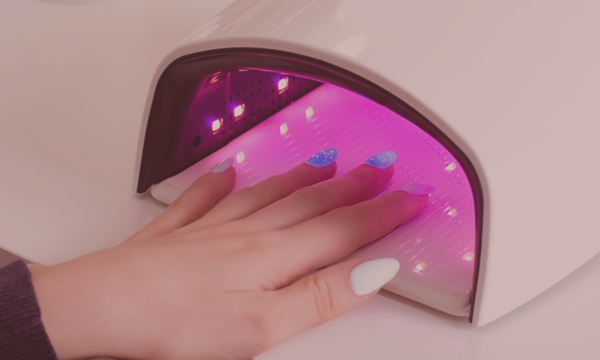
The LuluNails 36W–60W UV/LED lamp features several timer settings and two power levels to suit various compatible UV/LED products.
However, always follow the instructions for the product you are using.
How should you position your hand under the lamp?
A detail that is often overlooked.
Your fingers must be positioned correctly so that your nails receive the light properly.
Avoid:
- curled fingers;
- thumb turned completely inwards;
- hand positioned too far away;
- fingernail hidden by the position of the finger.
The thumb may sometimes require special attention, depending on the lamp and the position of the hand.
Does a more powerful lamp cure twice as fast?
No.
A lamp with a higher wattage does not automatically mean that you can halve the curing time.
The time is determined by:
- the formulation;
- the lamp technology;
- the thickness;
- the product protocol.
If a colour specifies a certain curing time, stick to it rather than making up a shorter time just because your lamp is powerful.
What should you do immediately if the varnish shrinks?
You’ve just applied the colour and already see a bare patch?
Do not cure an incorrect application straight away.
Step 1
Check whether the product has simply been applied unevenly.
ÉStep 2
Using your brush, gently reposition the material.
&Step 3
If the problem reoccurs immediately, check the surface.
&Step 4
Check the amount of product.
Step 5
If necessary, correct the preparation before continuing.
Applying several layers on top of a problematic area is not usually the best solution.
Protocol for the even application of Semi-Permanent Nail Polish
Here is a simple method.
1. Prepare the cuticles
Gently push back the cuticles without damaging the skin.
2. Shape the nails
File the free edge to the desired shape.
3. Gently prepare the nail plate
Follow the system’s protocol without filing the natural nail too aggressively.
4. Remove dust
Carefully remove all particles.
5. Apply the preparation products
Use Cleaner, Nail Prep or Primer only as required and in accordance with the protocol.
6. Apply the Base Coat
Work neatly and cure according to the recommendations.
7. First colour coat
Apply a thin coat.
8. Check the edges
No product should come into contact with the skin.
9. Cure
Use a compatible lamp and the recommended curing time.
10. Second coat
Apply another thin coat if necessary.
11. Cure
Observe the specified curing time.
12. TopTop Coat
Finish with your top coat and cure according to the instructions.
How can you achieve a more intense colour without applying a thick layer?
This is particularly important with:
- white;
- red;
- burgundy;
- black;
- certain pastels;
- highly pigmented colours.
Do not try to make the first layer completely opaque.
A slightly more transparent but even first coat is preferable to applying a large amount of paint.
Then add the second coat.
The colour gradually becomes more intense whilst maintaining a controlled thickness.
What temperature should you store your Semi-Permanent Nail Polish at?
Nail care products must be stored in accordancethe manufacturer’s recommendations.
In particular, avoid:
- direct sunlight;
- immediate proximity to a UV/LED lamp;
- significant heat sources;
- extreme temperatures.
Also, close the bottle when not in use.
A curing lamp left on near an open bottle may expose the product to light unnecessarily.
Why should bottles be resealed quickly during application?
A UV/LED bottle must be protected from light, which may interact with its formula.
In the salon, when several products are on the table, avoid leaving bottles open directly next to the lamp.
Take the colour you need, apply it, then close the bottle.
This is good professional practice.
Which base coat should you choose if the colour often shrinks?
Before changing your base coat, first identify the cause.
If your preparation is correct but your system isn’t suited to your nail type, you may then wish to consider a different base coat.
Depending on your needs, LuluNails offers the following, amongst others:
- Base Coat;
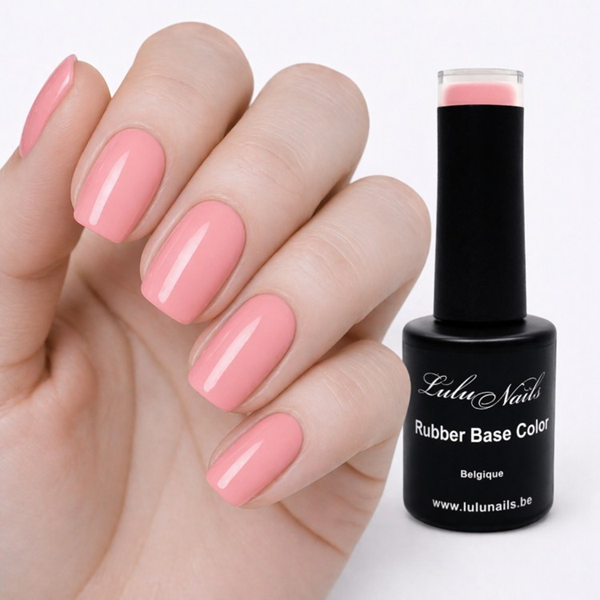
- Rubber Base;
- Rubber Base Colour;
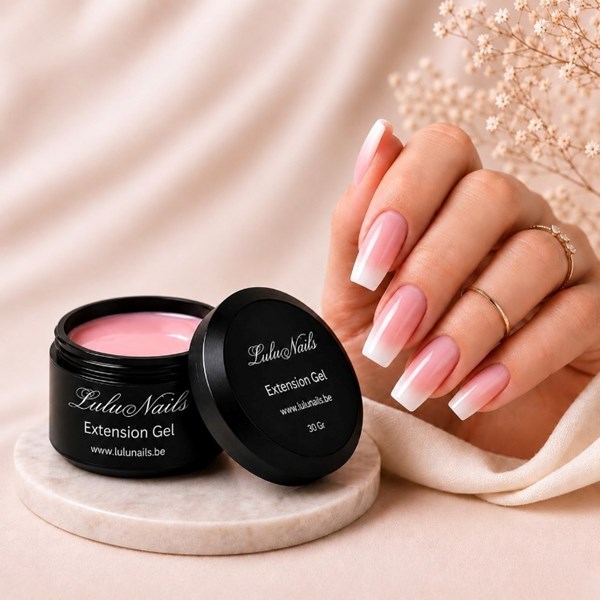
- Flexible Builder Gel.
The Base Coat is suitable for a classic application.
Rubber Base provides additional support for certain natural nails.
Builder Gel is primarily intended for strengthening and building.
The product should be chosen based on the nail itself, not just on the problem encountered.
Which LuluNails semi-permanent nail polishes should you choose?
LuluNails offers a wide range of UV/LED semi-permanent nail polishes in Belgium.
You can find colours such as:
- nude;
- pink;
- Milky;
- white;
- red;
- burgundy;
- brown;
- blue;
- green;
- trendy colours.
The relevant LuluNails ranges are formulated without HEMA or TPO.
Even with a formula free from HEMA and TPO, it is still essential to avoid any contact between the uncured product and the skin.
HEMA- and TPO-Free Semi-Permanent Nail Polish: why is technique still important?
“"HEMA- and TPO-free" does not mean that the product can be applied to the cuticles.
Professional application must always be precise.
In particular, ensure:
- preparation;
- thickness;
- curing;
- product compatibility;
- avoiding contact with the skin.
Product quality and application technique go hand in hand.
Diagnostic Table: what problem are you experiencing?
| Problem | Points to check |
|---|---|
| Varnish shrinking | Surface, residues, amount of product, basic procedure |
| Small holes in the colour | Contamination, surface, application |
| Varnish running | Excess product, viscosity, application too slow |
| Varnish wrinkling | Coating too thick, curing, lamp |
| Soft varnish after curing | Polymerisation, thickness, compatibility |
| Surface slightly sticky but firm | May be a normal dispersion layer |
| Bubbles | Trapped air, application, excessive stirring |
| Brush marks | Amount, pressure, texture |
| Irregular colour | Coats too thick or uneven application |
| Peeling after a few days | Preparation, free edge, skin, adhesion |
FAQ – Semi-Permanent Nail Polish that Shrinks or Wrinkles
Why does my semi-permanent nail polish shrink immediately?
First, check the surface preparation, any residue or oiliness, the amount of product used, and your Base Coat application procedure.
Why does the polish leave small holes?
Holes may appear when the product is not evenly distributed across certain areas. Check that the plate is clean, the preparation and the thickness of the colour.
Why does my gel polish crack after curing under the lamp?
A coat that is too thick or incorrect curing are among the causes that should be checked as a priority.
Why does my gel polish remain sticky after curing?
Some products retain a sticky dispersion layer after curing. If the material is firm and stable, this may be normal. Check the product instructions.
Why does my varnish remain soft beneath the top coat?
This may indicate insufficient polymerisation, particularly if the coat is too thick or the lamp/protocol.
Do I need to degrease the Base Coat before applying colour?
Not always. Follow the instructions for your Base Coat. Some systems require the dispersion layer to be retained.
Why does the gel run into the cuticles?
You may be using too much product, or its texture may be too runny for your working speed.
Can a third coat be applied if the colournot opaque?
It depends on the product. Where multiple coats are permitted, they must remain thin and be properly cured between each application.
Why do dark colours crease more easily?
Highly pigmented colours in particular require strict adherence to the film thickness and curing times specified by the manufacturer.
Is the wattage of the lamp the most important factor?
No. Compatibility between the lamp and the product, the curing time and the correct hand position are also essential.
Why does the problem only occur with the thumbs?
The position of the thumbs under the lamp may differfrom that of the other fingers. Check that they are correctly positioned according to your lamp’s design.
Can you touch the nail after preparation?
It is best to avoid this. Contact with your fingers may redeposit oils or residues onto the prepared nail plate.
Can a Rubber Base help prevent certain problems?
A Rubber Base may be suitable for certain types of nails, but it does not automatically correct poor preparation or curing.
Where can I buy professional semi-permanent nail polish in Belgium?
LuluNails offers a range of UV/LED semi-permanent nail polishes, as well as Base Coat, Rubber Base, Top Coats, preparation products and lamps for nail salons in Belgium.
Achieve Perfect Semi-Permanent Nail Polish Results with LuluNails
If your semi-permanent nail polish shrinks, develops gaps, runs or becomes wrinkled, don’t immediately replace your entire collection of products.
Start by identifying exactly what the problem is and when it occurs.
Above all, remember:
A clean and properly prepared surface.
Thin coats.
No product on the skin.
Curing in accordance with the protocol.
Compatible lamp.
Products suitable for the technique.
Discover at LuluNails Belgium the semi-permanent nail polishes, base coat, rubber base, top coat, cleaner, nail prep and UV/LED lamps you need to create your designs.
LuluNails – Belgian brand specialisingin professional nail products in Liège and online in Belgium.